
%20--%3e%3cpath%20d='M2025.4,806.8c-2.5,20.1-16.2,38.2-34.5,45.1-3.4,1.3-8.4,2.3-14.6,3.2-14.2,1.9-34.3,2.8-53.7,2.7h-.2c-23.1-.1-45.1-1.7-54.4-4.4-2.5-.7-4.9-1.6-7.2-2.7-.2,0-.3-.2-.5-.2-8.2-3.8-15.6-9.8-21.1-17.1-5.7-7.6-9.4-16.8-10-27,0,0,0,0,0,0-.5-3.1-.8-6.3-1.1-9.7-.5-7.2-.9-16.4-1-26.5h281.9c0-63.9-2.2-130.2-61.1-167.8-37.4-23.8-95.6-24.8-152.9-22.2-52.8,2.3-90.5,17.6-115.3,46.6-24.2,28.3-35.5,68.9-34.5,125.8h0c.2,12.6,1,26,2.4,40.2.3,3.1.6,6.2,1,9.4,2.9,25.9,12.9,50.3,28.9,70.4,10.9,13.8,24,24.9,38.8,32.8,7.6,4.1,15.7,7.4,24.1,9.8,17.8,5,52.5,7.8,87.8,7.8s64.2-2.2,84.5-7.1c2.9-.7,5.5-1.4,7.8-2.2,45-15,82.5-60.5,85.6-106.7h-80.6ZM2025.3,709.9h-198.3v-2.6c0-33.2,26.7-58.2,64.8-58.2h72.8c30.3,0,60.8,24.9,60.8,58.2v2.6Z'/%3e%3cpath%20d='M1620.8,806.8c-2.5,20.1-16.2,38.2-34.5,45.1-3.4,1.3-8.4,2.3-14.6,3.2-14.2,1.9-34.3,2.8-53.7,2.7h-.2c-23.1-.1-45.1-1.7-54.4-4.4-2.5-.7-4.9-1.6-7.2-2.7-.2,0-.3-.2-.5-.2-8.2-3.8-15.6-9.8-21.1-17.1-5.7-7.6-9.4-16.8-10-27,0,0,0,0,0,0-.5-3.1-.8-6.3-1.1-9.7-.5-7.2-.9-16.4-1-26.5h281.9c0-63.9-2.2-130.2-61.1-167.8-37.4-23.8-95.6-24.8-152.9-22.2-52.8,2.3-90.5,17.6-115.3,46.6-24.2,28.3-35.5,68.9-34.5,125.8h0c.2,12.6,1,26,2.4,40.2.3,3.1.6,6.2,1,9.4,2.9,25.9,12.9,50.3,28.9,70.4,10.9,13.8,24,24.9,38.8,32.8,7.6,4.1,15.7,7.4,24.1,9.8,17.8,5,52.5,7.8,87.8,7.8s64.2-2.2,84.5-7.1c2.9-.7,5.5-1.4,7.8-2.2,45-15,82.5-60.5,85.6-106.7h-80.6ZM1620.8,709.9h-198.3v-2.6c0-33.2,26.7-58.2,64.8-58.2h72.8c30.3,0,60.8,24.9,60.8,58.2v2.6Z'/%3e%3cpath%20d='M2968.1,806.8c-2.5,20.1-16.2,38.2-34.5,45.1-3.4,1.3-8.4,2.3-14.6,3.2-14.2,1.9-34.3,2.8-53.7,2.7h-.2c-23.1-.1-45.1-1.7-54.4-4.4-2.5-.7-4.9-1.6-7.2-2.7-.2,0-.3-.2-.5-.2-8.2-3.8-15.6-9.8-21.1-17.1-5.7-7.6-9.4-16.8-10-27,0,0,0,0,0,0-.5-3.1-.8-6.3-1.1-9.7-.5-7.2-.9-16.4-1-26.5h281.9c0-63.9-2.2-130.2-61.1-167.8-37.4-23.8-95.6-24.8-152.9-22.2-52.8,2.3-90.5,17.6-115.3,46.6-24.2,28.3-35.5,68.9-34.5,125.8h0c.2,12.6,1,26,2.4,40.2.3,3.1.6,6.2,1,9.4,2.9,25.9,12.9,50.3,28.9,70.4,10.9,13.8,24,24.9,38.8,32.8,7.6,4.1,15.7,7.4,24.1,9.8,17.8,5,52.5,7.8,87.8,7.8s64.2-2.2,84.5-7.1c2.9-.7,5.5-1.4,7.8-2.2,45-15,82.5-60.5,85.6-106.7h-80.6ZM2968,709.9h-198.3v-2.6c0-33.2,26.7-58.2,64.8-58.2h72.8c30.3,0,60.8,24.9,60.8,58.2v2.6Z'/%3e%3cpath%20d='M2402,586.8c-33.3-9.5-98.1-9.6-133.7-3.3-28.1,4.9-55.3,19.7-76.7,41.5-21.4,21.8-35.7,49.3-40.3,77.5-10.8,65.9,0,123.9,30.3,163.2,24.8,32.1,61.3,50.7,108.4,55.2,14.2,1.3,27.5,2,40.1,2,30.6,0,56.9-4,79.6-12,39.8-14,69.4-40,86-79.2,8.9-20.9,11.3-36.7,11.3-59.5v-1h-78.2s1.1,63.5-43.7,75.9c-26.4,6.3-75.2,4-98.6,2.3-17.8-1.3-31.6-7.1-41-17.3-9-9.8-14.2-24-15.4-42.1-1.9-28.8-2.6-90.3,7.3-109.2,7.1-13.5,21.4-23.8,37.3-27,23-4.5,98.1-4.2,117.7,3.4,37.1,14.4,36.3,55.9,36.3,55.9h78.2v-2c0-26.6-10.5-55.1-31.4-78.7-19.5-21.9-47-37.8-73.7-45.4Z'/%3e%3crect%20x='2557.8'%20y='492.7'%20width='80.1'%20height='422.1'/%3e%3cpolygon%20points='1119.3%20831.5%201007.4%20585.6%20913.1%20585.6%201065%20913.6%201065.5%20914.8%201173%20914.8%201325.4%20585.6%201231.2%20585.6%201119.3%20831.5'/%3e%3cpolygon%20points='265%20601.6%20265%20810.4%20627.6%201019.1%20627.6%201019.1%20627.6%201019.1%20627.6%201019.1%20627.6%201019.1%20808.9%20914.8%20808.9%20706%20627.6%20810.4%20265%20601.6'/%3e%3cpolygon%20points='808.9%20706%20808.9%20497.2%20627.6%20601.5%20808.9%20706'/%3e%3c/svg%3e)
Embedded simulation cost: published prices stop where the checkout stops
I spent an afternoon trying to price the whole embedded simulation ladder, bottom to top, using only numbers a stranger can open in a browser.
The bottom two tiers took ninety seconds. The top two took a procurement database.
The easy story is that the prices vanish because fidelity gets expensive, and expensive things get negotiated. The public evidence supports a narrower answer. Published prices disappear when the buying motion moves from checkout to configuration and procurement. The available records do not reveal a clean fidelity threshold.
Once you see that, the ladder stops looking like a cliff and starts looking like two different businesses stacked on top of each other.
I use "simulation ladder" broadly here. Its upper rungs are remote benches and closed-loop HIL, not simulation in the same sense as Wokwi or Renode. They belong in the comparison because firmware teams budget across all of them to answer progressively more physical questions.
First, kill the six-figure floor
The line you hear is that hardware-in-the-loop starts at six figures. It is repeated enough that people budget around it, which usually means they never open the conversation at all.
Public spending records disagree.
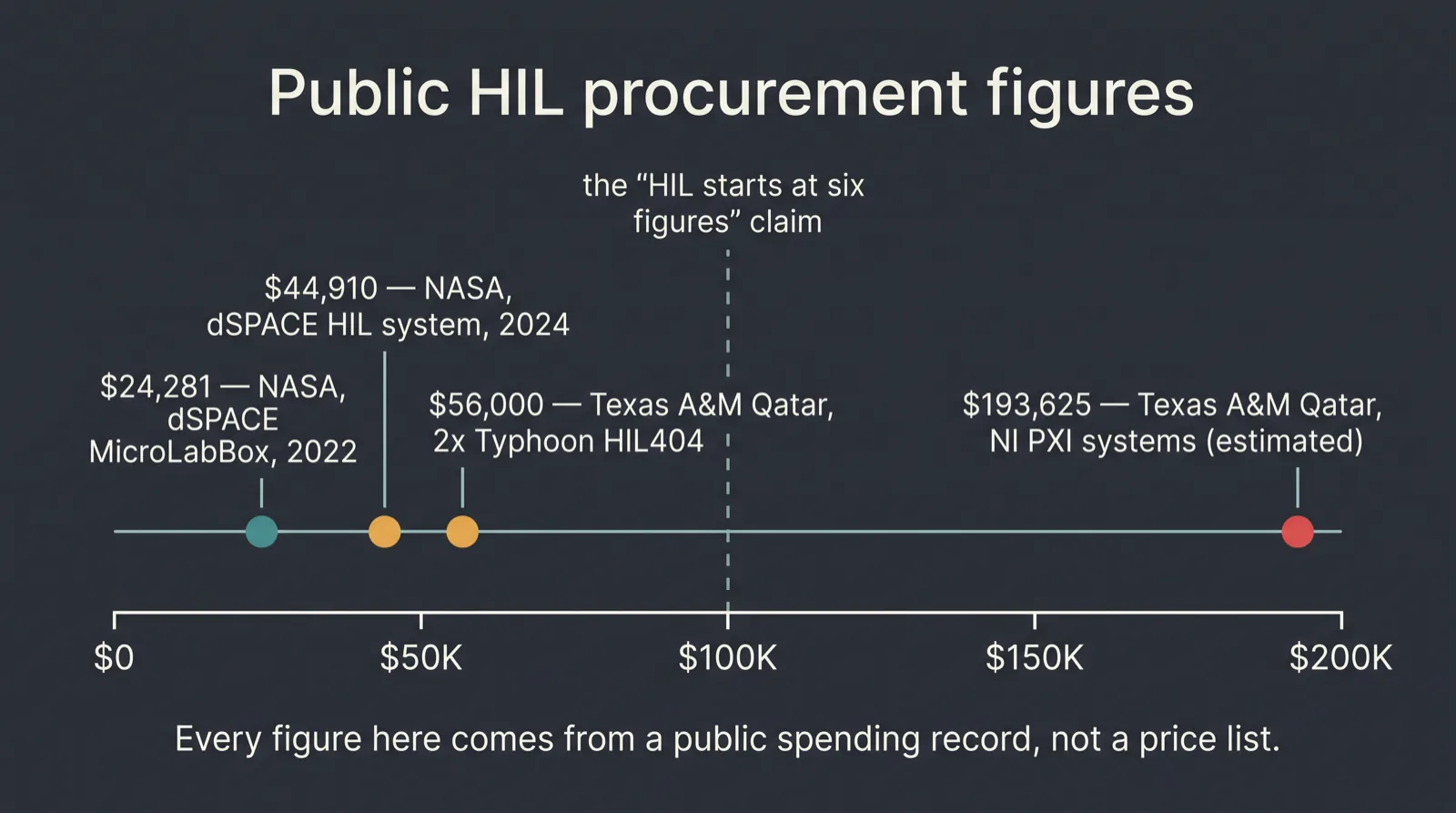
NASA obligated $24,281.18 to dSPACE Inc. on 2022-10-25, contract 80NSSC23PA076, described in the award record as "MICRO LAB BOX HARDWARE IN THE LOOP SYSTEM AND SOFTWARE."1 The same agency obligated $44,910.00 to the same vendor on 2024-08-01, contract 80NSSC24PB920, described as "DSPACE HARDWARE-IN-THE-LOOP SYSTEM."2
Texas A&M University at Qatar ran a public bid for two Typhoon HIL404 real-time simulators — hardware, permanent academic device licenses, premium toolbox packages, six breakout boards, six dSPACE interface boards, and shipping to Doha. Total awarded: $56,000.00.3
The same university's transparency portal carries a bid for National Instruments PXI systems — four PXIe-1062Q chassis, four PXIe-8840 controllers, waveform generators, digitizers, cabling — at an estimated value of $193,625.44.4 That figure is the estimate written on the bid document, not an award total, and PXI is a modular instrument platform rather than a HIL rig as such. It is, however, how a lot of labs actually build one.
These four public records span roughly $24K to $194K. Three sit below six figures, which is enough to kill the claim that HIL universally starts there. It is not enough to establish a market floor: configurations, existing licenses, support and procurement terms differ.
One more thing those four records have in common: not one of dSPACE, Typhoon HIL, or National Instruments publishes a list price for these configurations. Every number above exists because a public institution had to disclose what it spent. That is not a price list. It is procurement evidence.
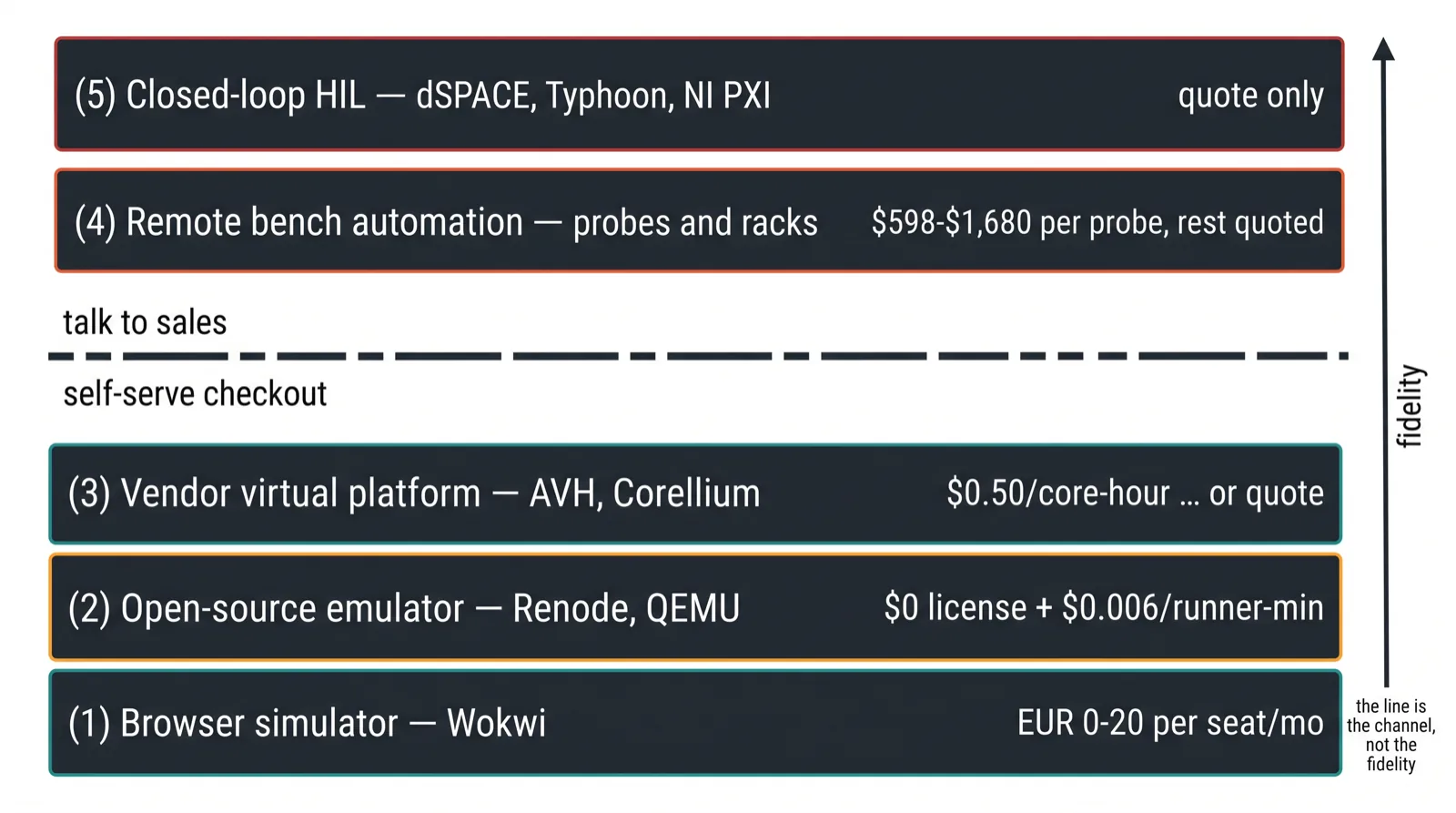
The five tiers, with what is actually public
This is a map of public purchasing units, not an apples-to-apples total-cost comparison. A seat-month, a runner-minute, a core-hour, a probe and a configured HIL procurement buy different things.
| Tier | What it is | Public price | What you get for it |
|---|---|---|---|
| Browser simulator | Wokwi | €0 Community, €5.60/mo Hobby, €8.10/mo Hobby+, €20/seat/mo Pro, all annual billing5 | A circuit at a URL. Pro adds 1,000 fast build minutes and 2,000 CI minutes |
| Open-source emulator | Renode, QEMU | $0 license (Renode is MIT6); compute is $0.006/min on a GitHub-hosted Linux 2-core x64 runner7 | Register-level peripheral models, scriptable regressions, no vendor relationship |
| Vendor virtual platform | Arm Virtual Hardware powered by Corellium | $0.50 per core hour on AWS Marketplace8 | Cloud-native Arm boards over REST, billed only while running |
| Remote bench automation | Probe farms | J-Link BASE Classic $598, J-Link Pro PoE $1,6809 | Real silicon, reachable from CI — the probes are priced, the rack around them is not |
| Closed-loop HIL | dSPACE, Typhoon HIL, NI PXI | No list price published; procurement records span $24,281.18 to $193,625.441234 | Plant models, real-time I/O, the only tier that can close a control loop |
Read that table top to bottom and the fidelity story looks convincing. Read the price column and something else shows up.
Where the number actually disappears
Wokwi publishes four tiers to the cent. Wokwi also sells a Classroom license, and the Classroom button says "get a quotation."5 Same simulator, same fidelity, same peripherals. One channel has a checkout, the other has a form. The price is public on exactly one of them.
Corellium is the sharper version. Its virtualization powers Arm Virtual Hardware, sold on AWS Marketplace at a published $0.50 per core hour, with the billing unit spelled out in the listing: one processor core running for one hour, each core counted separately.8 Corellium's enterprise tiers are quote-only. I am not going to put a number on them, because there isn't one to put — an undisclosed price is undisclosed, not "around" anything. Identical technology, two channels, one published rate.
That is the whole pattern. AWS Marketplace forces a unit and a rate into a public page, so the rate is public. A field sales team does not, so it isn't. Nothing about the silicon model changed between those two sentences.
The tier where prices stop is tier 4, not tier 5. Debug probes are catalog items with sticker prices — SEGGER lists J-Link BASE Classic at $598 and J-Link Pro PoE, the model explicitly sold for test farms, at $1,680.9 The moment you ask what it costs to turn forty of those into a scheduled, remotely reachable board farm, you are in a conversation, not a cart. Remote bench automation is where the ladder goes quiet, and it is a full tier below the one everyone blames.
Cost is not fidelity, and the ladder is not a queue
The temptation with a table like that is to read price as a proxy for how much truth you get. It is not, in either direction.
A GitHub-hosted Linux runner at $0.006 a minute, driving Renode, will catch a regression on every commit across as many board variants as you care to define. A $193,625 PXI rack will not do that, because there is one of it and forty people want it on Thursday. That is the scarcity problem I wrote about in simulation vs HIL: what belongs in CI — the expensive tier is expensive per slot, and slots are what you run out of.
Going the other way: a $598 probe on a real Nucleo will show you brown-out behavior, analog settling, and clock drift that no tier below it models at all. A third-party comparison of Wokwi against Renode and QEMU puts the same ceiling in writing: Wokwi "does not simulate timing-precise peripherals or complex real-time behavior. Always verify with physical hardware for production systems."10 Cheapest tier, and even outside reviewers agree on where it stops. The tier map in Wokwi vs Renode vs QEMU is a routing decision, not a ranking, and the price column does not change that.
The useful mental model: tiers 1 through 3 buy you repetitions. Tier 5 buys you verdicts on things only physics can answer. Tier 4 is the one that decides whether the verdicts arrive in a pull request or in a lab notebook three weeks later, and it is also the one nobody will quote you on a web page.
Budgeting this without a price list
Three questions, in order.
What claim are you trying to refute? If it is "this build boots and this state machine advances," you are shopping in tiers 1 to 3, where everything is priced and you can compute your annual bill in a spreadsheet this afternoon. If it is "this ECU behaves under a real plant model," you are in tier 5 and you are getting on a call.
How many slots do you need, not how much fidelity? The $24K NASA line item and the $194K TAMU bid differ mostly by channel count and I/O, not by whether they are "real" HIL. Size the I/O first; the price follows it far more tightly than it follows the brand.
Is your bottleneck actually tier 4? A pile of boards CI cannot reach is not a simulation budget problem. It is a bench automation problem wearing a simulation budget's clothes, and it is exactly the tier where you will have to ask for a number instead of reading one.
If you are starting from "which simulator," the ladder itself is laid out in Wokwi alternatives for professional firmware work. This post is only about what each rung costs, and about the fact that the answer stops being public well before the fidelity gets interesting.
Sources
Footnotes
-
USAspending.gov, award 80NSSC23PA076, NASA to DSPACE INC, signed 2022-10-25, total obligated $24,281.18, description "MICRO LAB BOX HARDWARE IN THE LOOP SYSTEM AND SOFTWARE." https://www.usaspending.gov/award/CONT_AWD_80NSSC23PA076_8000_-NONE-_-NONE- ↩ ↩2
-
USAspending.gov, award 80NSSC24PB920, NASA to DSPACE INC, signed 2024-08-01, total obligated $44,910.00, description "DSPACE HARDWARE-IN-THE-LOOP SYSTEM." https://www.usaspending.gov/award/CONT_AWD_80NSSC24PB920_8000_-NONE-_-NONE- ↩ ↩2
-
Texas A&M University Procurement Services, contract transparency portal, bid document 8862, "HIL404 Real-Time Simulator," Texas A&M University at Qatar; total bid and total awarded $56,000.00. https://spar.tamu.edu/Transparency/GetFile?dir=ItbRfpDocs&id=8862 — browsable index at https://purchasing.tamu.edu/purchasing/spar.html ↩ ↩2
-
Texas A&M University Procurement Services, contract transparency portal, bid document 8036, "PXI Systems; National Instruments for Texas A&M University at Qatar," estimated value $193,625.44. https://spar.tamu.edu/Transparency/GetFile?dir=ItbRfpDocs&id=8036 — browsable index at https://purchasing.tamu.edu/purchasing/spar.html ↩ ↩2
-
Wokwi, "Wokwi Plan and Pricing." Community €0/mo, Hobby €5.6/mo, Hobby+ €8.1/mo, Wokwi Pro €20/seat/mo, all annual billing; Pro includes 1,000 fast build minutes and 2,000 CI minutes; Classroom is quotation-based. https://wokwi.com/pricing ↩ ↩2
-
Renode, GitHub repository ("License & contributions"). https://github.com/renode/renode ↩
-
GitHub Docs, "Actions runner pricing." Linux 2-core (x64), billing SKU
actions_linux, $0.006 per minute. https://docs.github.com/en/billing/reference/actions-minute-multipliers ↩ -
AWS Marketplace, "Arm Virtual Hardware powered by Corellium," sold by Corellium, Inc. Usage cost dimension "core hours," $0.50 per core hour. https://aws.amazon.com/marketplace/pp/prodview-3ert36ne4rlmq ↩ ↩2
-
SEGGER USA web shop, "J-Link (Debug Probe)" category. J-Link BASE Classic (8.08.00) $598.00; J-Link Pro PoE (8.12.28) $1,680.00. https://shop-us.segger.com/product-category/debug-probes/jlink/ ↩ ↩2
-
Industrial Monitor Direct, "Wokwi vs Renode vs QEMU: Embedded System Simulators Comparison" — a third-party vendor guide, not an official Wokwi publication — as previously cited in our Wokwi alternatives writeup. https://industrialmonitordirect.com/blogs/knowledgebase/wokwi-vs-renode-vs-qemu-embedded-system-simulators-comparison ↩