%20--%3e%3cpath%20d='M2025.4,806.8c-2.5,20.1-16.2,38.2-34.5,45.1-3.4,1.3-8.4,2.3-14.6,3.2-14.2,1.9-34.3,2.8-53.7,2.7h-.2c-23.1-.1-45.1-1.7-54.4-4.4-2.5-.7-4.9-1.6-7.2-2.7-.2,0-.3-.2-.5-.2-8.2-3.8-15.6-9.8-21.1-17.1-5.7-7.6-9.4-16.8-10-27,0,0,0,0,0,0-.5-3.1-.8-6.3-1.1-9.7-.5-7.2-.9-16.4-1-26.5h281.9c0-63.9-2.2-130.2-61.1-167.8-37.4-23.8-95.6-24.8-152.9-22.2-52.8,2.3-90.5,17.6-115.3,46.6-24.2,28.3-35.5,68.9-34.5,125.8h0c.2,12.6,1,26,2.4,40.2.3,3.1.6,6.2,1,9.4,2.9,25.9,12.9,50.3,28.9,70.4,10.9,13.8,24,24.9,38.8,32.8,7.6,4.1,15.7,7.4,24.1,9.8,17.8,5,52.5,7.8,87.8,7.8s64.2-2.2,84.5-7.1c2.9-.7,5.5-1.4,7.8-2.2,45-15,82.5-60.5,85.6-106.7h-80.6ZM2025.3,709.9h-198.3v-2.6c0-33.2,26.7-58.2,64.8-58.2h72.8c30.3,0,60.8,24.9,60.8,58.2v2.6Z'/%3e%3cpath%20d='M1620.8,806.8c-2.5,20.1-16.2,38.2-34.5,45.1-3.4,1.3-8.4,2.3-14.6,3.2-14.2,1.9-34.3,2.8-53.7,2.7h-.2c-23.1-.1-45.1-1.7-54.4-4.4-2.5-.7-4.9-1.6-7.2-2.7-.2,0-.3-.2-.5-.2-8.2-3.8-15.6-9.8-21.1-17.1-5.7-7.6-9.4-16.8-10-27,0,0,0,0,0,0-.5-3.1-.8-6.3-1.1-9.7-.5-7.2-.9-16.4-1-26.5h281.9c0-63.9-2.2-130.2-61.1-167.8-37.4-23.8-95.6-24.8-152.9-22.2-52.8,2.3-90.5,17.6-115.3,46.6-24.2,28.3-35.5,68.9-34.5,125.8h0c.2,12.6,1,26,2.4,40.2.3,3.1.6,6.2,1,9.4,2.9,25.9,12.9,50.3,28.9,70.4,10.9,13.8,24,24.9,38.8,32.8,7.6,4.1,15.7,7.4,24.1,9.8,17.8,5,52.5,7.8,87.8,7.8s64.2-2.2,84.5-7.1c2.9-.7,5.5-1.4,7.8-2.2,45-15,82.5-60.5,85.6-106.7h-80.6ZM1620.8,709.9h-198.3v-2.6c0-33.2,26.7-58.2,64.8-58.2h72.8c30.3,0,60.8,24.9,60.8,58.2v2.6Z'/%3e%3cpath%20d='M2968.1,806.8c-2.5,20.1-16.2,38.2-34.5,45.1-3.4,1.3-8.4,2.3-14.6,3.2-14.2,1.9-34.3,2.8-53.7,2.7h-.2c-23.1-.1-45.1-1.7-54.4-4.4-2.5-.7-4.9-1.6-7.2-2.7-.2,0-.3-.2-.5-.2-8.2-3.8-15.6-9.8-21.1-17.1-5.7-7.6-9.4-16.8-10-27,0,0,0,0,0,0-.5-3.1-.8-6.3-1.1-9.7-.5-7.2-.9-16.4-1-26.5h281.9c0-63.9-2.2-130.2-61.1-167.8-37.4-23.8-95.6-24.8-152.9-22.2-52.8,2.3-90.5,17.6-115.3,46.6-24.2,28.3-35.5,68.9-34.5,125.8h0c.2,12.6,1,26,2.4,40.2.3,3.1.6,6.2,1,9.4,2.9,25.9,12.9,50.3,28.9,70.4,10.9,13.8,24,24.9,38.8,32.8,7.6,4.1,15.7,7.4,24.1,9.8,17.8,5,52.5,7.8,87.8,7.8s64.2-2.2,84.5-7.1c2.9-.7,5.5-1.4,7.8-2.2,45-15,82.5-60.5,85.6-106.7h-80.6ZM2968,709.9h-198.3v-2.6c0-33.2,26.7-58.2,64.8-58.2h72.8c30.3,0,60.8,24.9,60.8,58.2v2.6Z'/%3e%3cpath%20d='M2402,586.8c-33.3-9.5-98.1-9.6-133.7-3.3-28.1,4.9-55.3,19.7-76.7,41.5-21.4,21.8-35.7,49.3-40.3,77.5-10.8,65.9,0,123.9,30.3,163.2,24.8,32.1,61.3,50.7,108.4,55.2,14.2,1.3,27.5,2,40.1,2,30.6,0,56.9-4,79.6-12,39.8-14,69.4-40,86-79.2,8.9-20.9,11.3-36.7,11.3-59.5v-1h-78.2s1.1,63.5-43.7,75.9c-26.4,6.3-75.2,4-98.6,2.3-17.8-1.3-31.6-7.1-41-17.3-9-9.8-14.2-24-15.4-42.1-1.9-28.8-2.6-90.3,7.3-109.2,7.1-13.5,21.4-23.8,37.3-27,23-4.5,98.1-4.2,117.7,3.4,37.1,14.4,36.3,55.9,36.3,55.9h78.2v-2c0-26.6-10.5-55.1-31.4-78.7-19.5-21.9-47-37.8-73.7-45.4Z'/%3e%3crect%20x='2557.8'%20y='492.7'%20width='80.1'%20height='422.1'/%3e%3cpolygon%20points='1119.3%20831.5%201007.4%20585.6%20913.1%20585.6%201065%20913.6%201065.5%20914.8%201173%20914.8%201325.4%20585.6%201231.2%20585.6%201119.3%20831.5'/%3e%3cpolygon%20points='265%20601.6%20265%20810.4%20627.6%201019.1%20627.6%201019.1%20627.6%201019.1%20627.6%201019.1%20627.6%201019.1%20808.9%20914.8%20808.9%20706%20627.6%20810.4%20265%20601.6'/%3e%3cpolygon%20points='808.9%20706%20808.9%20497.2%20627.6%20601.5%20808.9%20706'/%3e%3c/svg%3e)
The agent infrastructure map
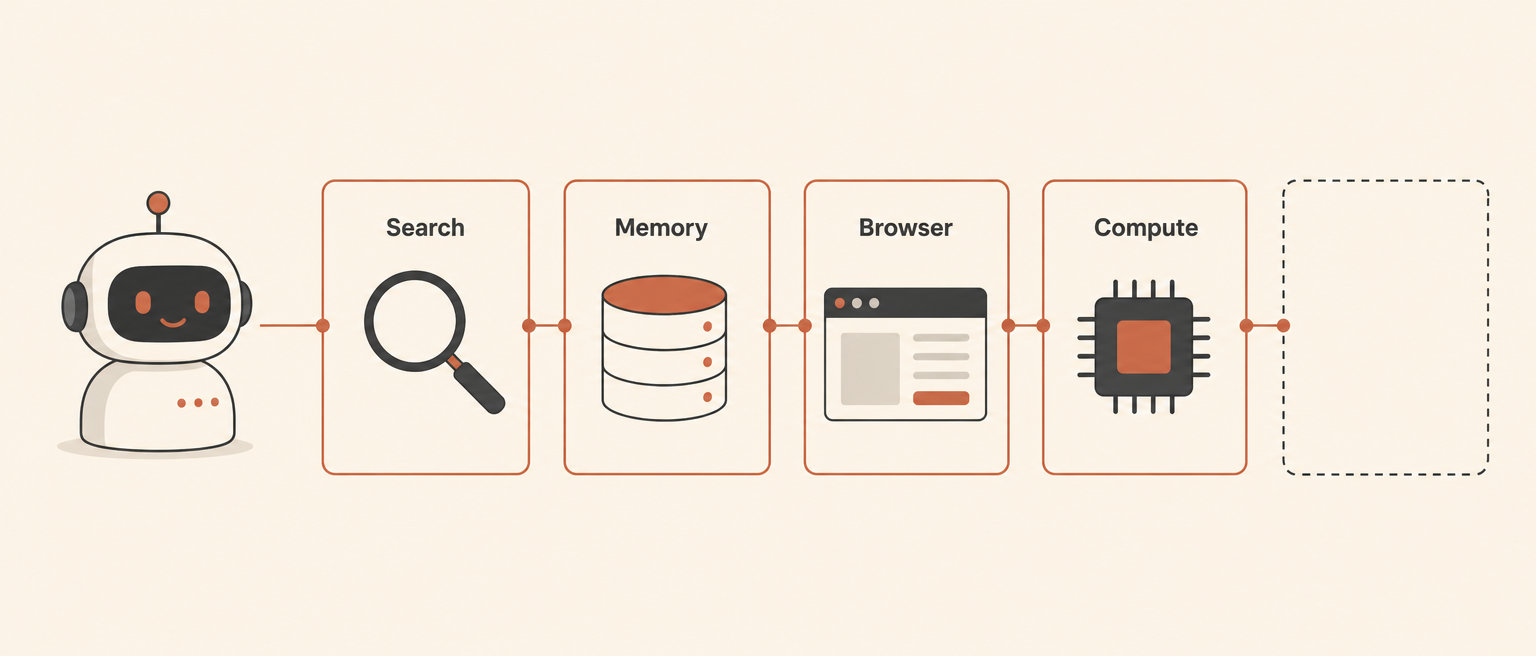
The agent changed how we think about infrastructure because agents work at machine speed. A human writes code once. An agent writes code a hundred times before lunch. A human reads a webpage. An agent reads a thousand webpages in parallel. That speed exposed a gap: the tools we built for humans don't scale to agents.
So the market filled the gap. Every agent capability became infrastructure — the AI agent infrastructure stack.
The AI agent infrastructure pattern
Five years ago, if you wanted to build an agent, you'd wire it to a search API, a database, a browser, and a sandbox. You'd own the integration. You'd own the reliability. You'd own the cost.
Today, you pick a company for each slot.
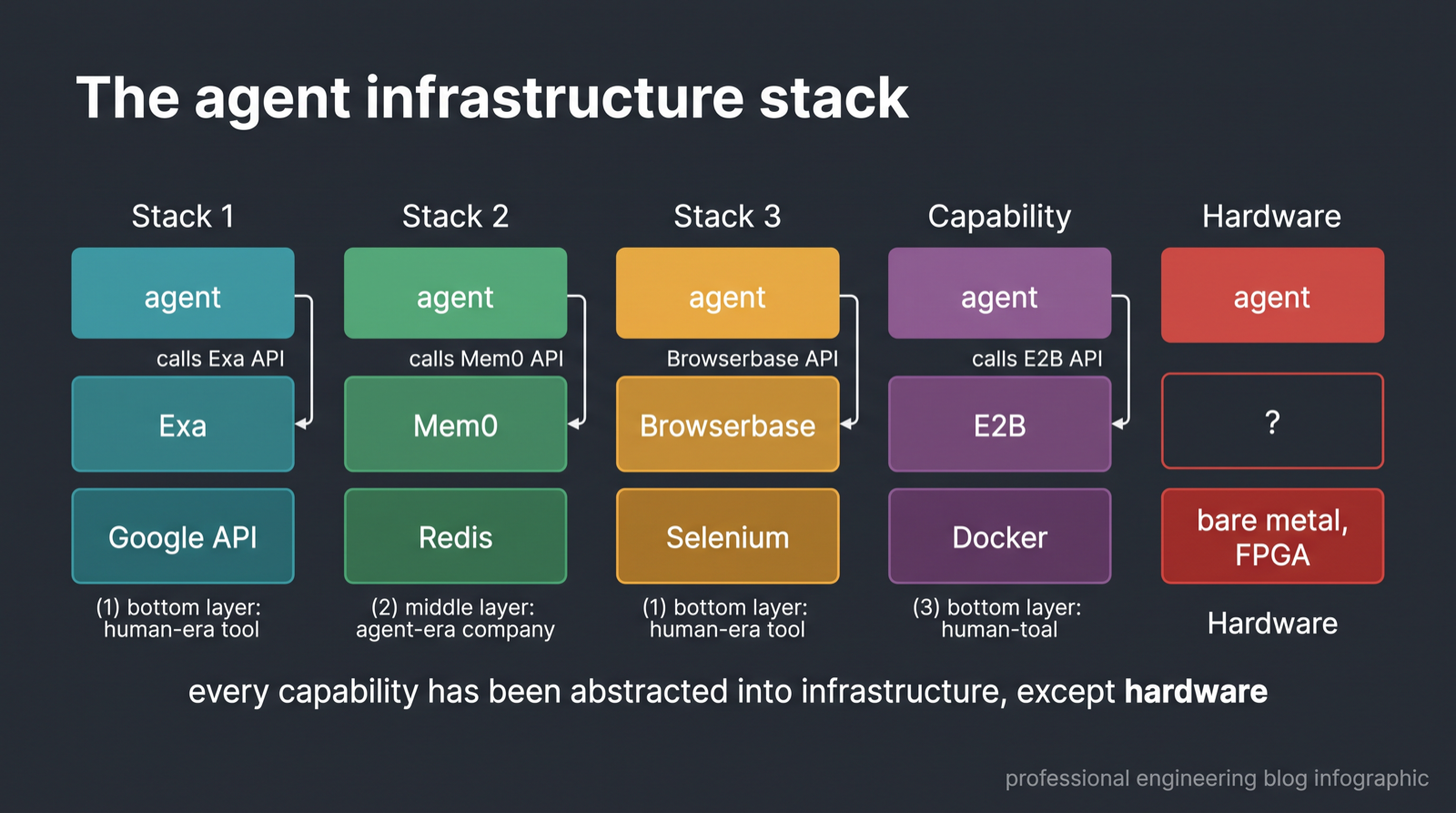
Search got Exa. Memory got Mem0. Browser got Browserbase.1 Compute got E2B.2 Each is a company, an API, a business model, a reliability contract, and a flag planted in a capability that used to be a feature of your application.
The pattern is clean: capability → infrastructure → company → API → billing.
| Capability | Human-era tool | Agent-era infrastructure | Status |
|---|---|---|---|
| Search | Google API, Bing API | Exa (custom search for AI) | Filled |
| Memory | Redis, Postgres | Mem0 (persistent agent memory) | Filled |
| Browser | Selenium, Puppeteer | Browserbase (browser-as-a-service) | Filled |
| Compute | Docker, Lambda | E2B (sandbox-as-a-service) | Filled |
| Hardware | Bare metal, FPGA | ? | Empty |
The first four slots are occupied. The last one isn't.
What "filled" looks like
When Exa filled the search slot, they built a search engine for AI. Exa's API returns structured outputs, citations, and search traces. It costs $0.10 per compute unit plus $0.005 per search call.3 You can set effort levels from minimal ($0.012/request) to xhigh ($1.00/request) depending on how much reasoning you need. The API is async, handles multi-step research, and returns grounded answers. That's infrastructure.
Mem0 filled the memory slot by making persistent memory a service. Instead of managing Redis yourself, you send Mem0 your conversations. It extracts facts, links entities, compresses context, and returns only the memories that matter for the next query.4 It runs on your infrastructure (self-hosted) or theirs (cloud), is SOC 2 and HIPAA compliant, and costs based on memory operations, not seat licenses. That's infrastructure.
Browserbase filled the browser slot by making the browser itself an API. You describe a task in natural language, and Browserbase runs an autonomous agent that navigates, clicks, extracts, and returns structured JSON.5 It handles anti-bot detection, CAPTCHA solving, and login flows, records sessions for debugging, and costs per browser-hour. That's infrastructure.
E2B filled the compute slot by making sandboxes instant and persistent. You call an API, get a Linux VM with sudo access, run code, and pause it. When you resume, the filesystem and memory are exactly as you left them.6 It costs by CPU-second and memory. That's infrastructure.
Each one has the same shape: API + billing + reliability + compliance.
Why hardware is still empty
Hardware is the hardest slot to fill because it's the most specific. Search is search. Memory is memory. Browsers are browsers. But hardware spans microcontrollers, FPGAs, wireless modules, sensors, actuators, and power supplies. An agent controlling a robot needs different hardware than an agent testing firmware. An agent on an edge device needs different hardware than an agent in the cloud.
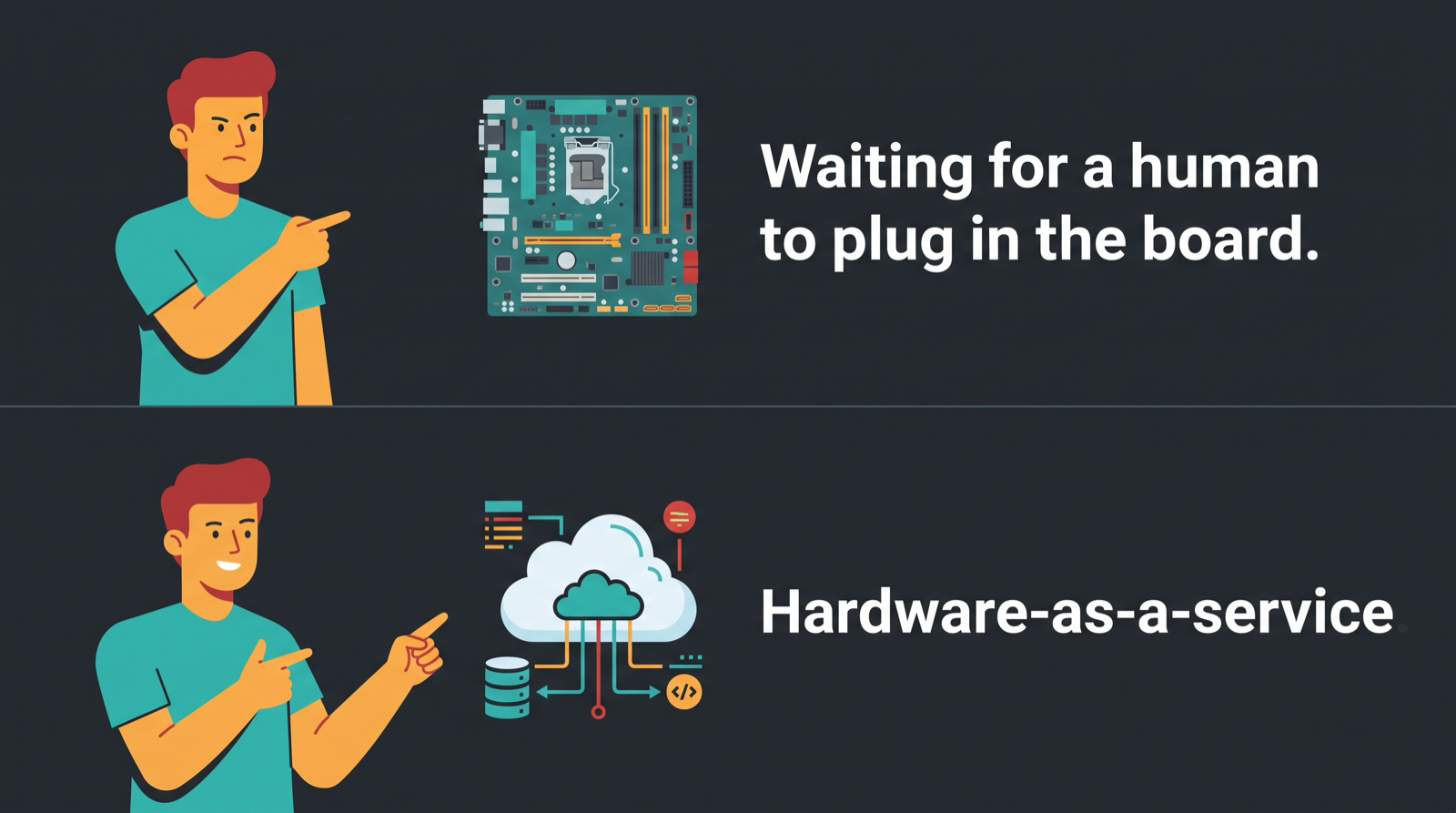
The human-era tools for hardware are still the human-era tools: bare metal, FPGA boards, dev kits, oscilloscopes. You buy them. You plug them in. You own them. You debug them. There's no API. There's no billing model. There's no company in the middle.
That's the gap.
An agent that writes firmware can test it on a virtual board in seconds. An agent that designs a circuit can simulate it in minutes. But an agent that needs to verify a design on real hardware still needs a human to plug in a board, flash a binary, and watch the output. That's not a bottleneck for one agent. It's a bottleneck for a thousand agents running in parallel.
The infrastructure exists. Chiplab runs firmware on virtual boards. Wokwi simulates circuits. AWS Device Farm runs tests on real phones. But none of them are positioned as agent infrastructure. None of them have the API shape that agents expect. None of them have the billing model that scales to agent speed.
The flag plant
The empty slot is a flag plant: this is where the next company will be.
When Exa filled the search slot, they repositioned search as infrastructure for agents. They built an API that agents expect, a billing model that scales to agent speed, and reliability that agents need.
The same will happen to hardware. Someone will take the infrastructure that exists — virtual boards, simulators, real hardware in the cloud — and reposition it as agent infrastructure: hardware is becoming an API, the same way servers, GPUs, phones, and browsers already did. They'll build an API that agents expect, a billing model that scales to agent speed, and reliability that agents need.
That's the pattern. That's the flag plant.
What the map tells us
The agent infrastructure map is a checklist. It says: if you're building an agent, you need these five things. Four of them are companies. One of them is still a gap.
The gap is an opportunity and a constraint. Until someone fills it, agents needing real hardware will be slower, more expensive, and harder to scale.
That's not a permanent constraint. It's a temporary one. The infrastructure exists. The API doesn't. Someone will build the API.
When they do, the map will be complete. And agents will be able to do something they can't do today: verify hardware at machine speed.
Where Chiplab fits
Chiplab runs firmware on virtual boards. It's not the hardware slot. It's the compute slot, specialized for firmware — filling exactly the gap E2B's sandboxes stop short of: a Linux box doesn't have a UART. You upload an ELF binary, specify a board, and get back a transcript of the UART output. It's an API. That's the whole interface.
But it's not the full hardware slot. It doesn't handle real hardware. It doesn't handle FPGAs. It doesn't handle circuits. It doesn't handle the full spectrum of hardware verification that agents need.
What it does is fill a gap in the compute slot. It says: if your agent writes firmware, you don't need a physical board to test it. You can test it on a virtual board in seconds and get the execution receipt that code-generation benchmarks can't provide. That's infrastructure. That's the shape agents expect.
The full hardware slot — the one that includes real hardware, FPGAs, circuits, and everything else — is still empty. But Chiplab is a piece of it. It's a flag plant in the firmware corner.
Sources
Footnotes
-
Jimmy Song, "The New Era of Cloud Agent Infrastructure: In-Depth Analysis of E2B and Browserbase Global Trends." https://jimmysong.io/blog/e2b-browserbase-report ↩
-
Blaxel, "Best Cloud Sandboxes for AI Agents in 2026." https://blaxel.ai/blog/best-cloud-sandboxes-ai-agents-2026 ↩
-
Exa, "Exa Agent API Guide." https://exa.ai/docs/reference/agent-api-guide ↩
-
Mem0, "Mem0 Platform Overview." https://docs.mem0.ai/platform/overview ↩
-
Browserbase, "Agents Overview." https://docs.browserbase.com/platform/agents/overview ↩
-
E2B, "E2B Documentation." https://e2b.dev/docs ↩