%20--%3e%3cpath%20d='M2025.4,806.8c-2.5,20.1-16.2,38.2-34.5,45.1-3.4,1.3-8.4,2.3-14.6,3.2-14.2,1.9-34.3,2.8-53.7,2.7h-.2c-23.1-.1-45.1-1.7-54.4-4.4-2.5-.7-4.9-1.6-7.2-2.7-.2,0-.3-.2-.5-.2-8.2-3.8-15.6-9.8-21.1-17.1-5.7-7.6-9.4-16.8-10-27,0,0,0,0,0,0-.5-3.1-.8-6.3-1.1-9.7-.5-7.2-.9-16.4-1-26.5h281.9c0-63.9-2.2-130.2-61.1-167.8-37.4-23.8-95.6-24.8-152.9-22.2-52.8,2.3-90.5,17.6-115.3,46.6-24.2,28.3-35.5,68.9-34.5,125.8h0c.2,12.6,1,26,2.4,40.2.3,3.1.6,6.2,1,9.4,2.9,25.9,12.9,50.3,28.9,70.4,10.9,13.8,24,24.9,38.8,32.8,7.6,4.1,15.7,7.4,24.1,9.8,17.8,5,52.5,7.8,87.8,7.8s64.2-2.2,84.5-7.1c2.9-.7,5.5-1.4,7.8-2.2,45-15,82.5-60.5,85.6-106.7h-80.6ZM2025.3,709.9h-198.3v-2.6c0-33.2,26.7-58.2,64.8-58.2h72.8c30.3,0,60.8,24.9,60.8,58.2v2.6Z'/%3e%3cpath%20d='M1620.8,806.8c-2.5,20.1-16.2,38.2-34.5,45.1-3.4,1.3-8.4,2.3-14.6,3.2-14.2,1.9-34.3,2.8-53.7,2.7h-.2c-23.1-.1-45.1-1.7-54.4-4.4-2.5-.7-4.9-1.6-7.2-2.7-.2,0-.3-.2-.5-.2-8.2-3.8-15.6-9.8-21.1-17.1-5.7-7.6-9.4-16.8-10-27,0,0,0,0,0,0-.5-3.1-.8-6.3-1.1-9.7-.5-7.2-.9-16.4-1-26.5h281.9c0-63.9-2.2-130.2-61.1-167.8-37.4-23.8-95.6-24.8-152.9-22.2-52.8,2.3-90.5,17.6-115.3,46.6-24.2,28.3-35.5,68.9-34.5,125.8h0c.2,12.6,1,26,2.4,40.2.3,3.1.6,6.2,1,9.4,2.9,25.9,12.9,50.3,28.9,70.4,10.9,13.8,24,24.9,38.8,32.8,7.6,4.1,15.7,7.4,24.1,9.8,17.8,5,52.5,7.8,87.8,7.8s64.2-2.2,84.5-7.1c2.9-.7,5.5-1.4,7.8-2.2,45-15,82.5-60.5,85.6-106.7h-80.6ZM1620.8,709.9h-198.3v-2.6c0-33.2,26.7-58.2,64.8-58.2h72.8c30.3,0,60.8,24.9,60.8,58.2v2.6Z'/%3e%3cpath%20d='M2968.1,806.8c-2.5,20.1-16.2,38.2-34.5,45.1-3.4,1.3-8.4,2.3-14.6,3.2-14.2,1.9-34.3,2.8-53.7,2.7h-.2c-23.1-.1-45.1-1.7-54.4-4.4-2.5-.7-4.9-1.6-7.2-2.7-.2,0-.3-.2-.5-.2-8.2-3.8-15.6-9.8-21.1-17.1-5.7-7.6-9.4-16.8-10-27,0,0,0,0,0,0-.5-3.1-.8-6.3-1.1-9.7-.5-7.2-.9-16.4-1-26.5h281.9c0-63.9-2.2-130.2-61.1-167.8-37.4-23.8-95.6-24.8-152.9-22.2-52.8,2.3-90.5,17.6-115.3,46.6-24.2,28.3-35.5,68.9-34.5,125.8h0c.2,12.6,1,26,2.4,40.2.3,3.1.6,6.2,1,9.4,2.9,25.9,12.9,50.3,28.9,70.4,10.9,13.8,24,24.9,38.8,32.8,7.6,4.1,15.7,7.4,24.1,9.8,17.8,5,52.5,7.8,87.8,7.8s64.2-2.2,84.5-7.1c2.9-.7,5.5-1.4,7.8-2.2,45-15,82.5-60.5,85.6-106.7h-80.6ZM2968,709.9h-198.3v-2.6c0-33.2,26.7-58.2,64.8-58.2h72.8c30.3,0,60.8,24.9,60.8,58.2v2.6Z'/%3e%3cpath%20d='M2402,586.8c-33.3-9.5-98.1-9.6-133.7-3.3-28.1,4.9-55.3,19.7-76.7,41.5-21.4,21.8-35.7,49.3-40.3,77.5-10.8,65.9,0,123.9,30.3,163.2,24.8,32.1,61.3,50.7,108.4,55.2,14.2,1.3,27.5,2,40.1,2,30.6,0,56.9-4,79.6-12,39.8-14,69.4-40,86-79.2,8.9-20.9,11.3-36.7,11.3-59.5v-1h-78.2s1.1,63.5-43.7,75.9c-26.4,6.3-75.2,4-98.6,2.3-17.8-1.3-31.6-7.1-41-17.3-9-9.8-14.2-24-15.4-42.1-1.9-28.8-2.6-90.3,7.3-109.2,7.1-13.5,21.4-23.8,37.3-27,23-4.5,98.1-4.2,117.7,3.4,37.1,14.4,36.3,55.9,36.3,55.9h78.2v-2c0-26.6-10.5-55.1-31.4-78.7-19.5-21.9-47-37.8-73.7-45.4Z'/%3e%3crect%20x='2557.8'%20y='492.7'%20width='80.1'%20height='422.1'/%3e%3cpolygon%20points='1119.3%20831.5%201007.4%20585.6%20913.1%20585.6%201065%20913.6%201065.5%20914.8%201173%20914.8%201325.4%20585.6%201231.2%20585.6%201119.3%20831.5'/%3e%3cpolygon%20points='265%20601.6%20265%20810.4%20627.6%201019.1%20627.6%201019.1%20627.6%201019.1%20627.6%201019.1%20627.6%201019.1%20808.9%20914.8%20808.9%20706%20627.6%20810.4%20265%20601.6'/%3e%3cpolygon%20points='808.9%20706%20808.9%20497.2%20627.6%20601.5%20808.9%20706'/%3e%3c/svg%3e)
Wokwi alternatives for professional firmware work
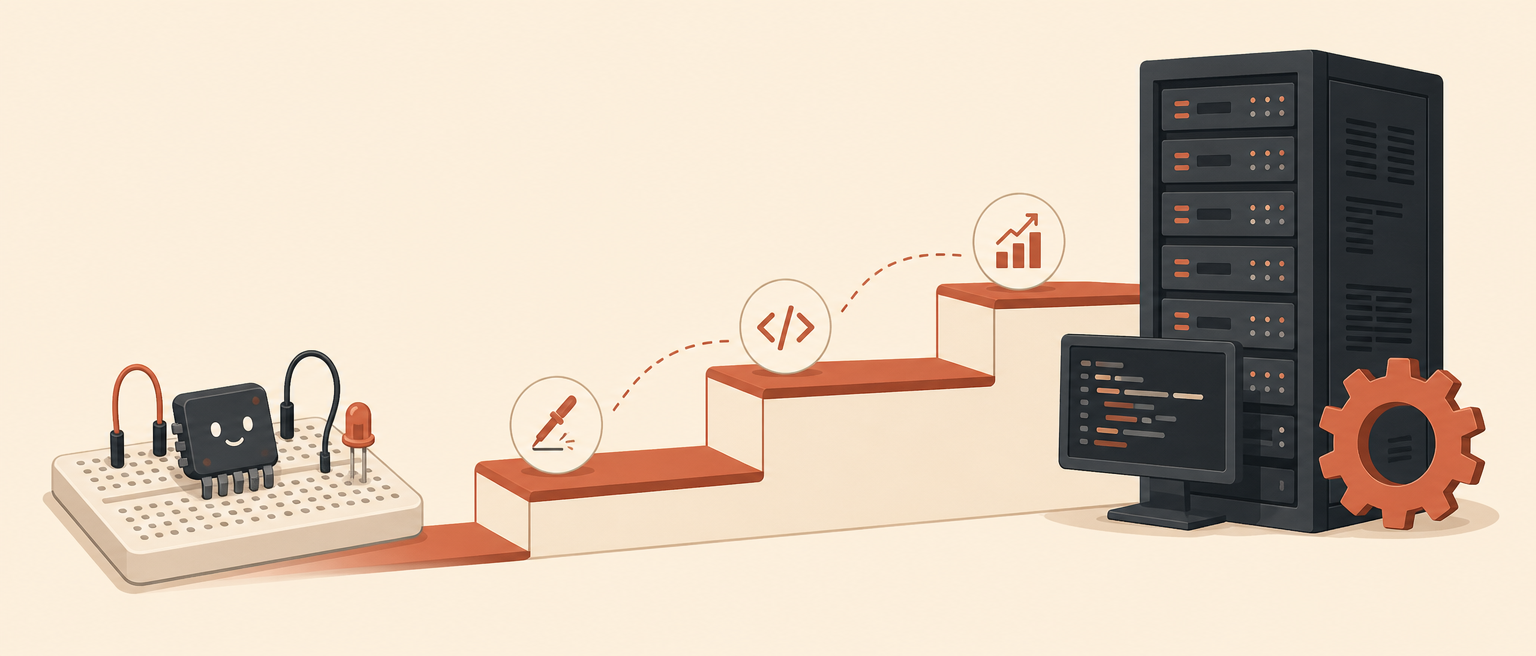
Someone on r/embedded asked what simulators people actually use for ARM Cortex-M development, "curious what others use... for actual development or mostly just for CI."1 Dozens of upvotes, dozens of comments, three usable answers: Renode, whatever ships with Zephyr, and "real hardware, no simulators." That's the honest state of the search "Wokwi alternatives" once you strip the SEO listicles: nobody agrees, because the question conflates five different tools solving five different problems.
I'm writing this because if you searched "Wokwi alternatives" and landed here, you've probably outgrown it — you need an embedded simulator for professionals: a build that survives a pull request, not a breadboard that survives a demo.
Give Wokwi its due
Wokwi is a browser-based circuit and firmware simulator for Arduino (Uno, Mega, Nano),
ESP32, STM32, and the Raspberry Pi Pico.2 You drop parts on a virtual breadboard,
write code, hit run, and watch LEDs blink with zero hardware on your desk. It's free
for personal use, unlimited simulations on the Community tier, and the paid tiers
(Hobby, Hobby+, Pro) buy faster builds, VS Code integration, and — this is the part
people miss — CI minutes: Wokwi Pro includes 2,000 monthly CI minutes and a
wokwi-ci-action GitHub Action for automated tests.2 It's also genuinely used by
working engineers, not just students: one Adafruit forum thread calls it "WAY better"
than anything else the poster had tried, unprompted, in a thread that wasn't about
Wokwi at all.3
Wokwi already has a CI story. What it lacks is peripheral fidelity below the behavioral level. Its own comparison against Renode and QEMU is blunt: "Wokwi does not simulate timing-precise peripherals or complex real-time behavior. Always verify with physical hardware for production systems."4 That's not a Wokwi-specific gap — it's the tier it's designed for: quick prototyping, tutorials, smoke-testing a library, checking GPIO logic before you touch a real board. If that's your job today, stop reading and go use it.
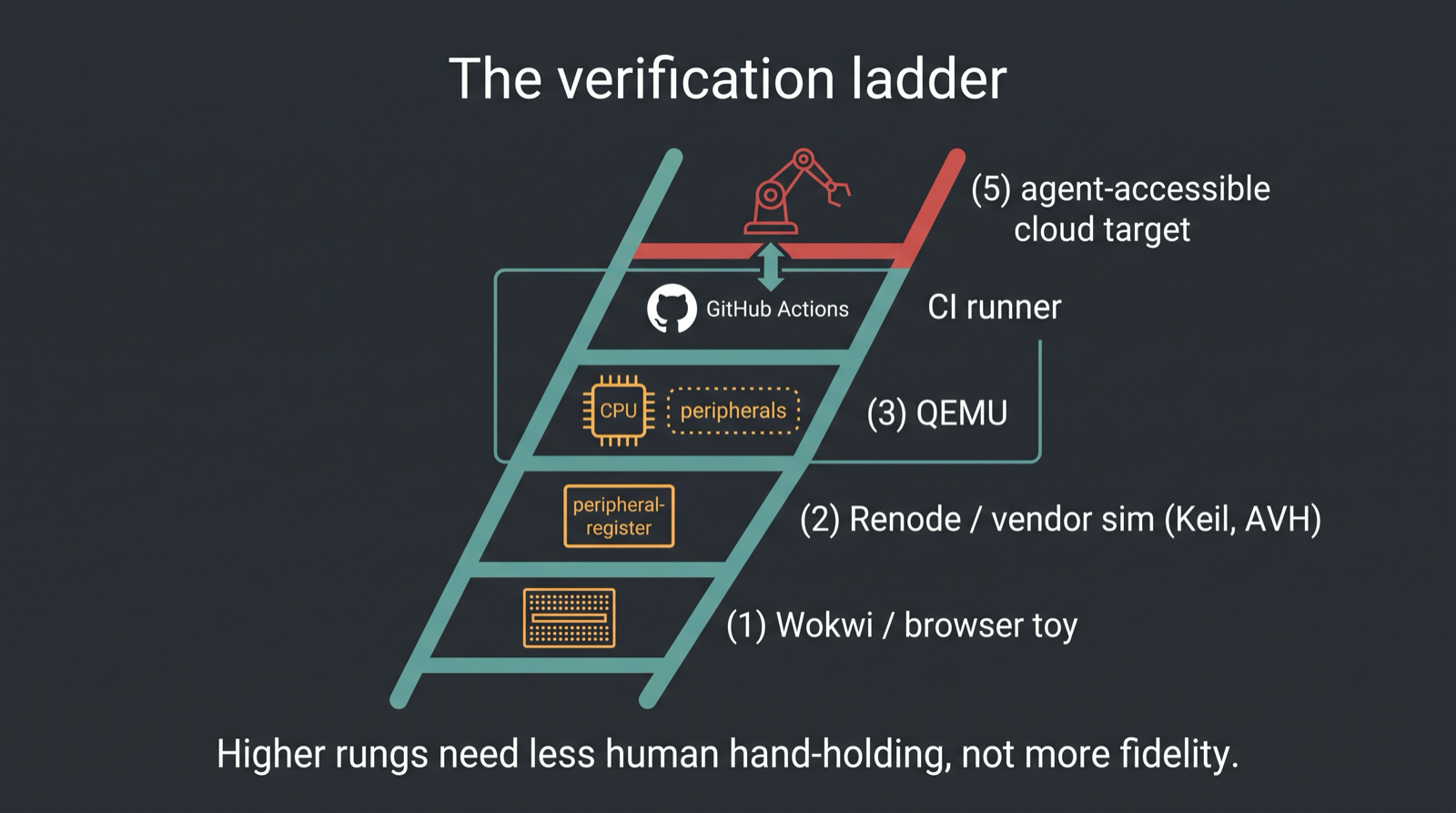
If your job is "does this firmware survive a pull request without a bench," you need tools further up the ladder.
The Wokwi alternative nobody puts on a listicle
The tool that actually shows up when working engineers answer "what do you use for ARM Cortex-M" is Renode. Antmicro built it as an open-source, MIT-licensed5 simulation framework specifically for pre-silicon and CI-stage embedded work — Cortex-M, Cortex-A, Cortex-R, RISC-V, and more, with peripheral models for UART, SPI, I2C, GPIO, timers, and sensors.6 Zephyr and TensorFlow Lite Micro both use it in their own CI: Pete Warden, who leads TensorFlow's mobile/embedded team, put it plainly — "Renode gives us integrated software emulation for a lot of Arm and RISC-V devices, and we rely on it for our testing."7
Renode gets recommended over QEMU for firmware work because it offers deterministic multi-node execution and a testing framework built in. It ships with a Robot Framework integration and an official GitHub Action, so a pull request can run real test suites against simulated boards with logs and pass/fail reports, not just a boot check.8 That's the actual meaning of "CI-usable" for a simulator: not "can run headless," but "produces a result a CI system can gate on."
QEMU deserves the comparison — the Renode vs QEMU comparison covers the model-by-model detail — because it's the tool people reach for first out of habit: everyone already has it. For full Linux-class systems (Cortex-A) it's excellent, which is why it dominates that world. For microcontroller-class Cortex-M work, its own docs are candid about the boundary: STM32 support covers five boards — one F1, one F2, two F4 variants, and one L4. The F-series boards model the core, ADC, EXTI, USART, SPI, and timers but not GPIO or DMA; the L4 board flips that, adding GPIO but dropping ADC and the timer.9 A Memfault engineer summed up the reputation: "QEMU is focused on emulating systems meant for higher-level OSes... rather than embedded devices."10 Whichever board you pick, something your firmware actually touches is missing.
Vendor sims are a real tier, not a fallback
If your stack is already Keil or IAR, you have a simulator sitting inside your toolchain that's easy to forget counts as one. Keil MDK ships an instruction-set simulator in µVision and, since MDK-Professional, includes Arm Virtual Hardware (AVH) at no extra cost — functionally accurate Fixed Virtual Platforms for select Cortex-M designs. That's Arm's own term, not the stricter cycle-accurate bar. AVH is built for CI and MLOps pipelines and is free for evaluation, open-source, and non-commercial use via Arm's Tools Artifactory.11 It's also listed on AWS Marketplace as a subscription SaaS product for cloud-scale runs beyond a laptop.12
PlatformIO sits in an adjacent lane worth naming precisely so it doesn't get lumped in as a simulator: it's a build and test runner, and its "native" test mode compiles your hardware-independent logic for your host CPU and runs it there — no chip simulation at all, deliberately.13 That's a different, valid layer: fast unit tests for the parts of your firmware that don't touch a register. It's not competing with Renode; it's one rung of the pyramid over.
The table
| Tool | Sweet spot | Chips covered | Peripheral fidelity | CI-usable? | Agent-accessible? | Price |
|---|---|---|---|---|---|---|
| Wokwi | Prototyping, learning, quick sketches | Arduino Uno/Mega/Nano, ESP32, STM32, RP20402 | Behavioral (LEDs, sensors, common buses); not timing-precise4 | Yes — wokwi-cli + GitHub Action, CI minutes on Pro2 | Experimental — local MCP server via wokwi-cli mcp (stdio, needs CLI + token)14 | Free (Community) → €20/seat/mo (Pro)2 |
| Renode | Pre-silicon and CI regression on Cortex-M/A/R, RISC-V | Wide, community-modeled — dozens of ARM and RISC-V platforms6 | High — models UART, SPI, I2C, GPIO, timers, deterministic multi-node6 | Yes — built-in Robot Framework + official GitHub Action8 | Scriptable via CLI/Python; no built-in HTTP/agent API | Free, open source (MIT)5 |
| QEMU (M-profile) | Full-system A-profile emulation; narrow M-profile support | 5 STM32 boards (F1, F2, 2x F4, L4); core support broader than board support9 | Core: good, but inconsistent per board — F-series skip GPIO/DMA, the L4 board skips ADC/timers9 | Yes — standard in many CI pipelines (e.g. Zephyr's qemu_cortex_m3) | Yes — plain CLI binary, trivially scriptable | Free, open source (GPL) |
| Keil MDK / Arm Virtual Hardware | Vendor-integrated core sim + functionally accurate FVPs for CI/MLOps | Whatever Keil supports, plus select Cortex-M reference platforms via AVH11 | High for core + basic peripherals; functionally accurate (not cycle-accurate) on supported AVH platforms12 | Yes — AVH built explicitly for CI/MLOps12 | Limited — GUI-first tooling; AVH FVPs are scriptable binaries | MDK: free (Community) → paid seats. AVH: free for eval/OSS/non-commercial, bundled with MDK-Professional, subscription SaaS on AWS1112 |
| PlatformIO (native test) | Fast host-side unit tests of hardware-independent logic | N/A — runs on host CPU, or real board via Remote13 | None by design — that's a different layer, not a chip model | Yes — this is its core use case13 | Yes — plain CLI (pio test) | Free (core), paid Enterprise tier |
| Chiplab | Agent-driven verification of AI-generated firmware, no desk required | STM32 and Nordic nRF families today, more on the roadmap15 | Byte-level peripheral behavior — accepts some config mistakes real silicon wouldn't, documented openly16 | Yes — designed as a CI gate | Yes — native MCP tool surface: upload, run, fetch artifacts | Free tier (50 credits/day), pay-as-you-go, enterprise15 |
"CI-usable" and "agent-accessible" are different columns
Most of the table says yes to CI-usable. Far fewer say yes to agent-accessible — that's the real gap once you're past "which simulator" and into "how does my coding agent use one without me in the loop."
CI-usable means a human wired a YAML file once, and now a pipeline runs the same script on every push — though green there doesn't mean correct; see why the build can pass and the firmware still doesn't run. Agent-accessible means an agent can, at inference time, decide to compile something, get a board to run it on, and read back a structured result — without a human pre-authoring the exact test it needs. Wokwi's CLI now ships an experimental local MCP server — credit due14 — but it's a stdio process an agent spawns locally, CLI and token required, not reachable over a network the way Chiplab is. Every other tool in the table still assumes a human wrote the harness in advance. That's fine for regression testing. It's the wrong shape for an agent iterating on code nobody has seen yet.
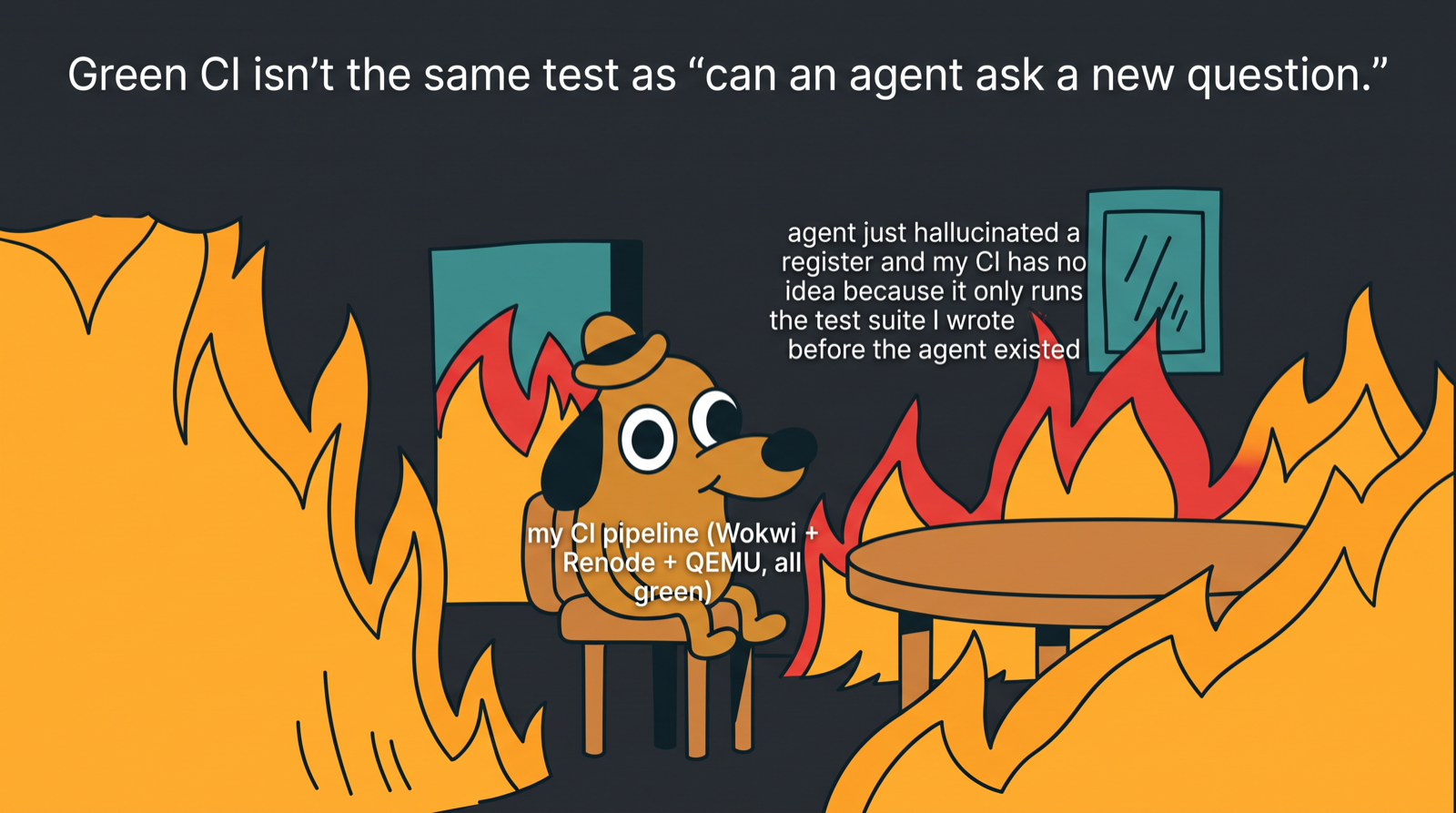
We built Chiplab to sit at the top rung most of these tools weren't designed for: not to replace any of them, but to handle agent-driven iteration. It's MCP-native — an agent gets an upload ticket, PUTs a compiled ELF, runs it on a virtual STM32 or nRF52 instance with the same peripherals and interrupt timing as the physical board, and reads the result back as a tool call, not a CI log a human has to parse.15 We're not pretending it's a free pass on fidelity either: it's byte-level peripheral modeling, and in our own testing it accepted a wrong baud divisor and a missing clock enable that real silicon wouldn't have forgiven — we published that limitation ourselves instead of hiding it.16 Every simulator has a scope. Knowing where yours ends is the actual skill.
Pick by question, not by brand
If the question is "does my code light the LED," Wokwi answers it in your browser in under a minute, and there's no reason to reach for anything heavier. If the question is "does this survive a pull request," you want Renode or a vendor sim wired into CI. If the question is "does this survive a full system boot on Linux-class hardware," that's QEMU's actual home turf, not M-profile microcontrollers. If the question is "can an agent ask this question a hundred times an hour without a human writing a new test each time," that's the rung none of the classic tools were built for — and it's the one we spend our time on.
Sources
Footnotes
-
r/embedded, "What simulators do you actually use for ARM Cortex-M development?" https://www.reddit.com/r/embedded/comments/1qnaepr/what_simulators_do_you_actually_use_for_arm ↩
-
Wokwi, "Pricing Plans", homepage, and CI docs. https://wokwi.com/pricing / https://wokwi.com / https://docs.wokwi.com/wokwi-ci/getting-started ↩ ↩2 ↩3 ↩4 ↩5
-
Adafruit Forums, "looking for an Arduino simulator." https://forums.adafruit.com/viewtopic.php?t=184640 ↩
-
Industrial Monitor Direct, "Wokwi vs Renode vs QEMU: Embedded System Simulators Comparison." https://industrialmonitordirect.com/blogs/knowledgebase/wokwi-vs-renode-vs-qemu-embedded-system-simulators-comparison ↩ ↩2
-
Renode, GitHub repository ("License & contributions"). https://github.com/renode/renode ↩ ↩2
-
Renode, "Supported boards" documentation. https://renode.readthedocs.io/en/latest/introduction/supported-boards.html ↩ ↩2 ↩3
-
Renode, homepage quotes (Pete Warden, TensorFlow Mobile/Embedded Team Lead, Google). https://renode.io ↩
-
Antmicro / Renode, "Renode GitHub Action for automated testing on simulated hardware" and "Testing with Renode" docs. https://renode.io/news/renode-github-action-for-automated-testing-in-simulation / https://renode.readthedocs.io/en/latest/introduction/testing.html ↩ ↩2
-
QEMU, "STMicroelectronics STM32 boards" documentation. https://www.qemu.org/docs/master/system/arm/stm32.html ↩ ↩2 ↩3
-
Interrupt (Memfault), "Cortex-M MCU Emulation with Renode." https://interrupt.memfault.com/blog/intro-to-renode ↩
-
Arm, "Virtual Hardware: Accelerate Software Development" (Costs section). https://www.arm.com/products/development-tools/simulation/virtual-hardware ↩ ↩2 ↩3
-
AWS Marketplace, "Arm Virtual Hardware powered by Corellium." https://aws.amazon.com/marketplace/pp/prodview-3ert36ne4rlmq ↩ ↩2 ↩3 ↩4
-
PlatformIO, "Unit Testing" documentation. https://docs.platformio.org/en/latest/advanced/unit-testing/index.html ↩ ↩2 ↩3
-
Wokwi documentation, "MCP Support." https://docs.wokwi.com/wokwi-ci/mcp-support ↩ ↩2
-
Chiplab documentation, pricing and overview. https://chiplab.veecle.ai/mcp/resources/docs/pricing.md / https://chiplab.veecle.ai/mcp/resources/docs/overview.md ↩ ↩2 ↩3
-
Veecle, "What LLMs get wrong about embedded code." https://veecle.ai/blog/05-what-llms-get-wrong ↩ ↩2