%20--%3e%3cpath%20d='M2025.4,806.8c-2.5,20.1-16.2,38.2-34.5,45.1-3.4,1.3-8.4,2.3-14.6,3.2-14.2,1.9-34.3,2.8-53.7,2.7h-.2c-23.1-.1-45.1-1.7-54.4-4.4-2.5-.7-4.9-1.6-7.2-2.7-.2,0-.3-.2-.5-.2-8.2-3.8-15.6-9.8-21.1-17.1-5.7-7.6-9.4-16.8-10-27,0,0,0,0,0,0-.5-3.1-.8-6.3-1.1-9.7-.5-7.2-.9-16.4-1-26.5h281.9c0-63.9-2.2-130.2-61.1-167.8-37.4-23.8-95.6-24.8-152.9-22.2-52.8,2.3-90.5,17.6-115.3,46.6-24.2,28.3-35.5,68.9-34.5,125.8h0c.2,12.6,1,26,2.4,40.2.3,3.1.6,6.2,1,9.4,2.9,25.9,12.9,50.3,28.9,70.4,10.9,13.8,24,24.9,38.8,32.8,7.6,4.1,15.7,7.4,24.1,9.8,17.8,5,52.5,7.8,87.8,7.8s64.2-2.2,84.5-7.1c2.9-.7,5.5-1.4,7.8-2.2,45-15,82.5-60.5,85.6-106.7h-80.6ZM2025.3,709.9h-198.3v-2.6c0-33.2,26.7-58.2,64.8-58.2h72.8c30.3,0,60.8,24.9,60.8,58.2v2.6Z'/%3e%3cpath%20d='M1620.8,806.8c-2.5,20.1-16.2,38.2-34.5,45.1-3.4,1.3-8.4,2.3-14.6,3.2-14.2,1.9-34.3,2.8-53.7,2.7h-.2c-23.1-.1-45.1-1.7-54.4-4.4-2.5-.7-4.9-1.6-7.2-2.7-.2,0-.3-.2-.5-.2-8.2-3.8-15.6-9.8-21.1-17.1-5.7-7.6-9.4-16.8-10-27,0,0,0,0,0,0-.5-3.1-.8-6.3-1.1-9.7-.5-7.2-.9-16.4-1-26.5h281.9c0-63.9-2.2-130.2-61.1-167.8-37.4-23.8-95.6-24.8-152.9-22.2-52.8,2.3-90.5,17.6-115.3,46.6-24.2,28.3-35.5,68.9-34.5,125.8h0c.2,12.6,1,26,2.4,40.2.3,3.1.6,6.2,1,9.4,2.9,25.9,12.9,50.3,28.9,70.4,10.9,13.8,24,24.9,38.8,32.8,7.6,4.1,15.7,7.4,24.1,9.8,17.8,5,52.5,7.8,87.8,7.8s64.2-2.2,84.5-7.1c2.9-.7,5.5-1.4,7.8-2.2,45-15,82.5-60.5,85.6-106.7h-80.6ZM1620.8,709.9h-198.3v-2.6c0-33.2,26.7-58.2,64.8-58.2h72.8c30.3,0,60.8,24.9,60.8,58.2v2.6Z'/%3e%3cpath%20d='M2968.1,806.8c-2.5,20.1-16.2,38.2-34.5,45.1-3.4,1.3-8.4,2.3-14.6,3.2-14.2,1.9-34.3,2.8-53.7,2.7h-.2c-23.1-.1-45.1-1.7-54.4-4.4-2.5-.7-4.9-1.6-7.2-2.7-.2,0-.3-.2-.5-.2-8.2-3.8-15.6-9.8-21.1-17.1-5.7-7.6-9.4-16.8-10-27,0,0,0,0,0,0-.5-3.1-.8-6.3-1.1-9.7-.5-7.2-.9-16.4-1-26.5h281.9c0-63.9-2.2-130.2-61.1-167.8-37.4-23.8-95.6-24.8-152.9-22.2-52.8,2.3-90.5,17.6-115.3,46.6-24.2,28.3-35.5,68.9-34.5,125.8h0c.2,12.6,1,26,2.4,40.2.3,3.1.6,6.2,1,9.4,2.9,25.9,12.9,50.3,28.9,70.4,10.9,13.8,24,24.9,38.8,32.8,7.6,4.1,15.7,7.4,24.1,9.8,17.8,5,52.5,7.8,87.8,7.8s64.2-2.2,84.5-7.1c2.9-.7,5.5-1.4,7.8-2.2,45-15,82.5-60.5,85.6-106.7h-80.6ZM2968,709.9h-198.3v-2.6c0-33.2,26.7-58.2,64.8-58.2h72.8c30.3,0,60.8,24.9,60.8,58.2v2.6Z'/%3e%3cpath%20d='M2402,586.8c-33.3-9.5-98.1-9.6-133.7-3.3-28.1,4.9-55.3,19.7-76.7,41.5-21.4,21.8-35.7,49.3-40.3,77.5-10.8,65.9,0,123.9,30.3,163.2,24.8,32.1,61.3,50.7,108.4,55.2,14.2,1.3,27.5,2,40.1,2,30.6,0,56.9-4,79.6-12,39.8-14,69.4-40,86-79.2,8.9-20.9,11.3-36.7,11.3-59.5v-1h-78.2s1.1,63.5-43.7,75.9c-26.4,6.3-75.2,4-98.6,2.3-17.8-1.3-31.6-7.1-41-17.3-9-9.8-14.2-24-15.4-42.1-1.9-28.8-2.6-90.3,7.3-109.2,7.1-13.5,21.4-23.8,37.3-27,23-4.5,98.1-4.2,117.7,3.4,37.1,14.4,36.3,55.9,36.3,55.9h78.2v-2c0-26.6-10.5-55.1-31.4-78.7-19.5-21.9-47-37.8-73.7-45.4Z'/%3e%3crect%20x='2557.8'%20y='492.7'%20width='80.1'%20height='422.1'/%3e%3cpolygon%20points='1119.3%20831.5%201007.4%20585.6%20913.1%20585.6%201065%20913.6%201065.5%20914.8%201173%20914.8%201325.4%20585.6%201231.2%20585.6%201119.3%20831.5'/%3e%3cpolygon%20points='265%20601.6%20265%20810.4%20627.6%201019.1%20627.6%201019.1%20627.6%201019.1%20627.6%201019.1%20627.6%201019.1%20808.9%20914.8%20808.9%20706%20627.6%20810.4%20265%20601.6'/%3e%3cpolygon%20points='808.9%20706%20808.9%20497.2%20627.6%20601.5%20808.9%20706'/%3e%3c/svg%3e)
Renode alternatives: what would actually make you switch
The best-ranked comparison I found while searching for Renode alternatives is hosted on the blog of a company that sells industrial panel PCs.1 Its table lists Renode's license as Apache 2.0. Renode is MIT, and has been for as long as the README has said so.2
That one wrong cell tells you everything about how the page was made. Nobody opened the repository. Nobody ran the tool. The article ends with a product block: "Recommended hardware — Run it on an industrial Panel PC." It's an ad with a comparison table stapled to the front.
I'm going to write the opposite of that, with an obvious conflict of interest I should declare in the second paragraph rather than the footer: we build on Renode. Which means this post is only worth writing if it's fair to Renode, and only worth reading if it tells you when to leave. A rigged comparison from a company that depends on the incumbent is worth less than nothing.
Organized by job, not by tool. For most board-level Cortex-M work, the answer to "what should I switch to" is don't.
The jobs, and which tool actually owns each one
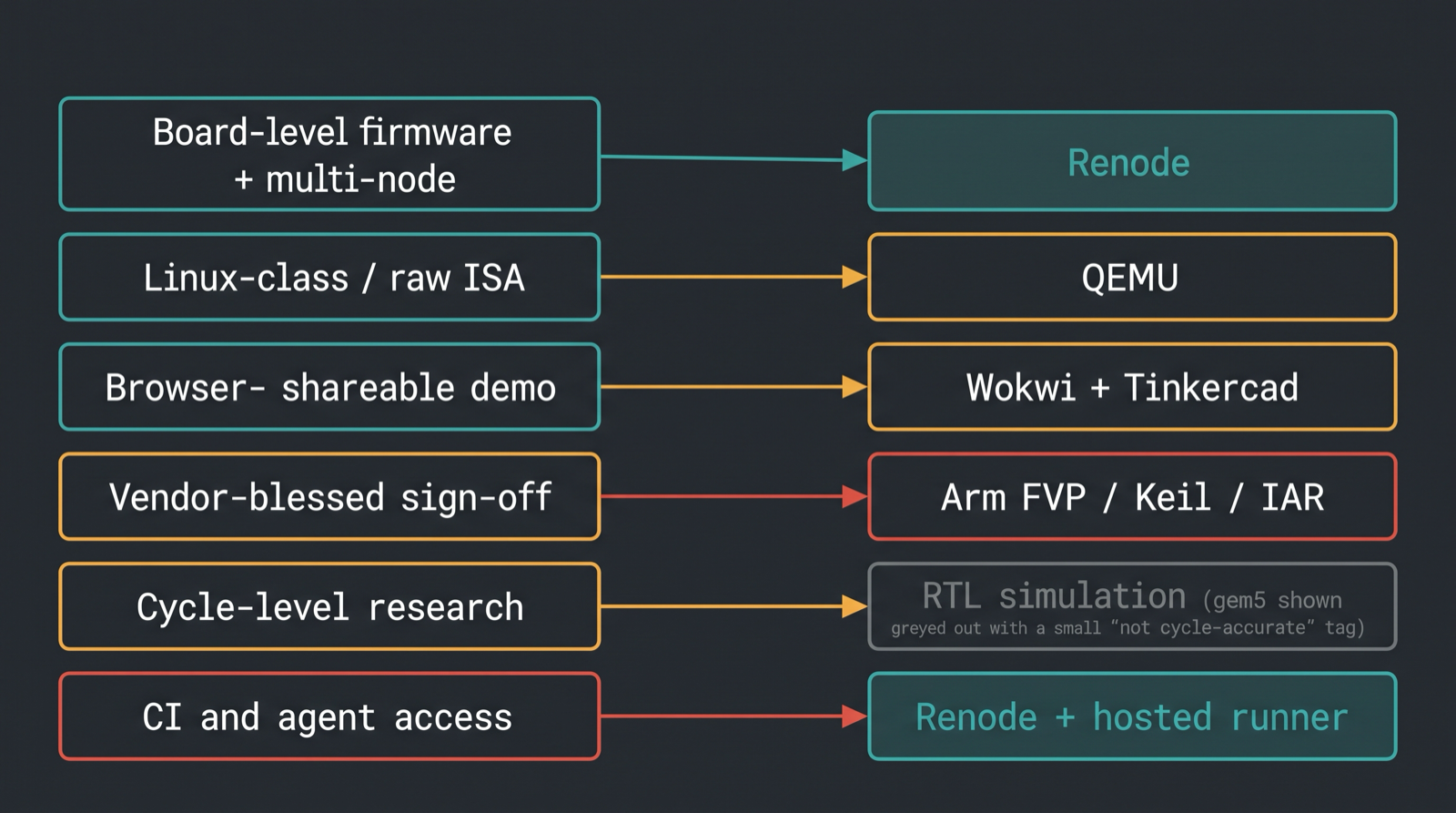
An embedded simulator comparison that lists tools alphabetically is useless: these things do not compete, they overlap at the edges and own different centers.
Board-level firmware simulation and multi-node systems. This is Renode's home turf and it isn't close. Text platform files describe peripherals and wire them to buses and interrupt lines.3 The whole thing is deterministic. You can run several nodes in one emulation and have them talk. There's a Robot Framework test integration in the box so CI gets pass/fail rather than "it didn't crash."4 If your job is "does this firmware boot and behave on this board, every pull request," you are already using the right tool.
Raw CPU and ISA emulation, Linux-class targets. QEMU. Not a consolation prize — for booting a kernel on Cortex-A this is the industry default and Renode isn't trying to take it. The trouble starts when people carry that reputation down to microcontrollers. QEMU's own STM32 page lists five machines: one F1, one F2, two F405 boards, and an L475 IoT node.5 No F4 Discovery. The shared "missing devices" list includes GPIO, DMA, I2C, CAN, and the RTC.5 Post 20 on what QEMU actually covers for Cortex-M goes through the gaps chip by chip, and what Renode and QEMU each model covers the Renode vs QEMU split at the peripheral level. Short version: QEMU is a superb CPU emulator with board models attached as an afterthought.
Hobby, teaching, and a link you can send someone. Wokwi and Tinkercad Circuits. Renode cannot do the one thing these do: produce a URL that opens a working circuit in a stranger's browser. Tinkercad is free and aimed squarely at learning;6 Wokwi runs unlimited simulations on a €0 Community tier and sells CI minutes on Pro.7 If your actual requirement is a shareable demo or a classroom, Renode is the wrong shape of tool and no amount of fidelity fixes that. I wrote the reverse trip — Wokwi alternatives for professional firmware work — for people going the other way.
Vendor-blessed fidelity. Keil and IAR ship simulators inside the IDE, and Arm ships Fast Models and the Fixed Virtual Platforms behind Arm Virtual Hardware. Arm's own words for these are "functionally accurate simulation models of Arm-based Cortex-M CPUs and Corstone-3xx subsystems"8 and "functionally accurate programmer's view models."9 That's Arm's claim, not mine, and note what it doesn't say. Cost: free via Arm Tools Artifactory for evaluation, open source, and non-commercial use; no extra charge with MDK-Professional; AWS AMI billed as infrastructure.10 The real pull here is provenance, not accuracy. Arm models the IP, so if you need a model somebody will sign next to, that's the aisle.
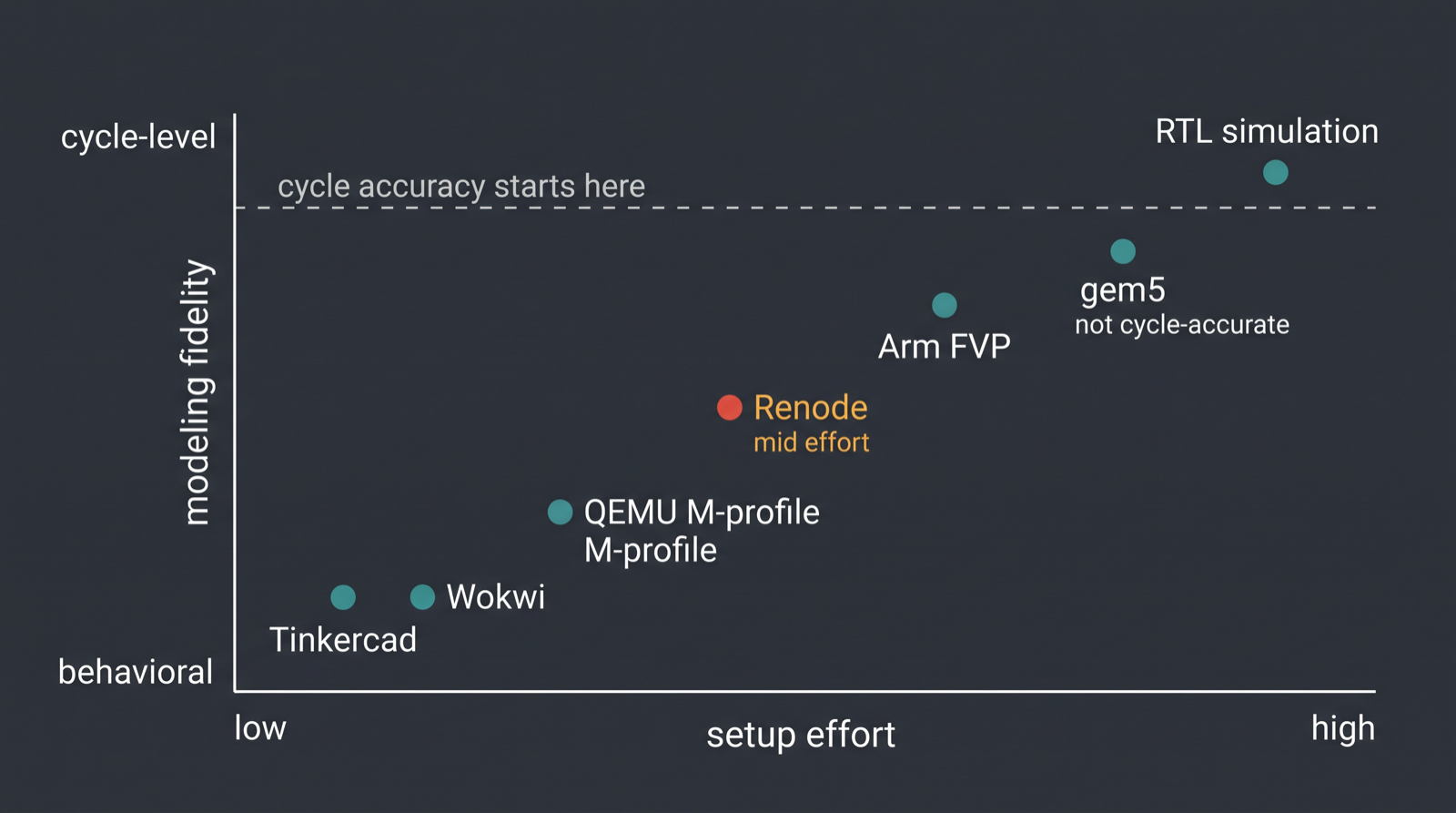
Cycle-level micro-architecture research. gem5, and this is where the fidelity conversation gets embarrassing for everyone. gem5's own official tutorial deck says, in bold, "gem5 is not a cycle-accurate microarchitecture model," and points at RTL simulation and commercial products like Arm Cycle Models for work that needs it.11 So the tool everybody names when they say "I need cycle accuracy" disclaims cycle accuracy. If you genuinely need it, you need RTL, and that is a different project with a different budget.
Running firmware in CI, or from an agent. Renode has a GitHub Action and a test framework, so CI is solved as long as a human wrote the harness first.412 "An agent decides at inference time to compile something and needs a board to run it on" is a different requirement — that's the one we work on with Chiplab, which is Renode-based and hosted, so the thing you're buying is that somebody else runs the infrastructure.13 Not a replacement for Renode. It is Renode, with an API and an on-call rotation.
The embedded simulator comparison table
Timing column wording is deliberate. Where a vendor makes the claim, it's attributed to the vendor.
| Tool | Genuinely best at | License / cost | Timing fidelity claim | MCU & board coverage | CI story | Pick this when |
|---|---|---|---|---|---|---|
| Renode | Board-level firmware, multi-node systems, deterministic reruns | MIT, free; Antmicro sells commercial support and new platforms2 | No cycle-accurate mode. Virtual time advances against a CPU performance setting in MIPS, default 10014 | Broad and community-extensible; the docs are candid that your case "may require extending the provided hardware description / models"15 | Robot Framework integration and a GitHub Action412 | Firmware has to survive a pull request without a bench |
| QEMU | Linux-class Arm and raw ISA emulation | Open source, free | Explicitly not cycle-accurate: "QEMU does not attempt to emulate how long an instruction would take on real hardware"16 | Five STM32 machines total; GPIO, DMA, I2C, CAN missing from the shared device list5 | Everywhere already; a plain binary you can script | Booting a kernel, or emulating an ISA rather than a board |
| Wokwi | A working circuit at a URL, plus a light CI path | €0 Community tier; Hobby from €5.60/mo; Pro €20/seat/mo with 2000 CI minutes7 | Not claimed | Arduino, ESP32, RP2040, some STM32 | wokwi-ci GitHub Action on paid tiers7 | The deliverable is a link somebody else can open |
| Tinkercad Circuits | Teaching, first-circuit, zero-install | Free web app6 | Not claimed | Arduino-class hobby parts | None | You are teaching, not shipping |
| Arm FVP / Virtual Hardware, Keil, IAR | Vendor provenance and pre-silicon Arm IP | Free via Arm Tools Artifactory for eval/OSS/non-commercial; bundled with MDK-Professional; AWS AMI billed as infra10 | Arm's term is "functionally accurate," for both FVPs and Fast Models89 | Arm reference subsystems and Corstone; whatever your IDE vendor supports | Built for CI and MLOps pipelines, scriptable binaries | You need a model with a vendor's name on it |
| gem5 | Micro-architecture research, cache and pipeline exploration | Open source | Its own tutorial: "gem5 is not a cycle-accurate microarchitecture model"11 | Research platforms, not production dev boards | Not the point of the tool | You are writing a paper about a pipeline |
Reasons you would actually switch away from Renode
If one of them is your situation, go.
- You need a defensible cycle count. Renode has no cycle-accurate mode; it advances virtual time against a MIPS number you configure, default 100.14 That's a budget, not a pipeline. Nothing in the open-source set gives you cycles — see what cycle-accurate actually means before you spend money on this.
- The board does not exist yet and you have no platform file. Renode needs a
.repldescribing your peripherals and their addresses.3 Writing one for a chip nobody has modeled is real work. If Arm already ships an FVP for the exact subsystem, take it. - A peripheral your firmware actually touches isn't modeled in your specific chip. Check first. But "modeled by the vendor sim, not by Renode" is a legitimate reason to use the vendor sim for that one thing.
- The deliverable is a shareable browser link. Renode will never be that.
- You need vendor-blessed sign-off. Provenance is a procurement requirement, not a technical one.
- Linux-class targets. QEMU.
- You want somebody else to operate it. Self-hosting a simulator is infrastructure. Hosted options exist, including ones built on Renode.
Reasons that look like reasons but are not
This section requires having used the tool.
"Renode is too slow." By default Renode deliberately slows down when virtual time
starts outrunning real time. There is a flag — AdvanceImmediately — that tells it to run
as fast as the host allows.14 People benchmark the default and conclude the tool is
slow.
"I need cycle accuracy." Almost always you need deterministic ordering, which Renode already gives you. Or you need a duration measured on silicon, which no simulator on this page will give you. And if a specific block really does need cycle-level behavior, Renode co-simulates HDL through Verilator or Questa over DPI — you keep the system model and drop in the RTL for the one block that matters.17 Switching frameworks to get that is strictly worse than not switching.
"My chip isn't supported." Platform descriptions are text files you can write and
using-include.3 Or you pay Antmicro, who wrote the framework and sells exactly this
service.2 Rewriting your test suite against a different simulator is more work than
modeling one UART.
"QEMU is the standard, everyone has it." For Cortex-A, sure. For your F4, QEMU does not ship a machine for your board and does not model GPIO.5
"It's open source, so there's no support." MIT license, commercial support from the vendor who maintains it.2 That's the same deal as most enterprise infrastructure.
"The UI is clunky." It's a monitor console you drive from a script. Ergonomics is a real complaint; it is not a fidelity argument, and migrating a verification stack over aesthetics is how teams lose a quarter.
Are there any real Renode alternatives?
For board-level Cortex-M work with peripherals, in 2026, no. QEMU wins on CPU coverage and loses on boards. gem5 wins on micro-architecture and isn't a firmware tool. The browser simulators win on approachability. The Renode license being MIT removes the last reason people usually go shopping.
What you should actually go shopping for is the thing around the simulator: who operates it, who writes the platform file for your chip, who gets paged when CI can't reach it. Those are procurement questions with real answers, and none of them are "use a different emulator."
If you searched "Renode alternatives" because Renode annoyed you this week, the fix is
probably a .repl file and an afternoon. If you searched it because your firmware needs a
number in nanoseconds that a court could look at, no tool on this page is your answer and
you should stop reading listicles written by panel PC vendors.
Sources
Footnotes
-
Industrial Monitor Direct, "ARM Cortex-M Simulators QEMU Renode Keil Comparison." https://industrialmonitordirect.com/de/blogs/knowledgebase/arm-cortex-m-simulators-qemu-renode-keil-comparison ↩
-
Renode, GitHub repository README, "License & contributions" and "Commercial support." https://github.com/renode/renode ↩ ↩2 ↩3 ↩4
-
Renode documentation, "Describing platforms." https://renode.readthedocs.io/en/latest/basic/describing_platforms.html ↩ ↩2 ↩3
-
Renode documentation, "Testing with Renode." https://renode.readthedocs.io/en/latest/introduction/testing.html ↩ ↩2 ↩3
-
QEMU documentation, "STMicroelectronics STM32 boards." https://www.qemu.org/docs/master/system/arm/stm32.html ↩ ↩2 ↩3 ↩4
-
Autodesk Tinkercad, "Circuits." https://www.tinkercad.com/circuits ↩ ↩2
-
Wokwi, "Pricing Plans." https://wokwi.com/pricing ↩ ↩2 ↩3
-
Arm, "Arm Virtual Hardware — Arm FVP Simulation Models" documentation. https://arm-software.github.io/AVH/main/simulation/html/index.html ↩ ↩2
-
Arm, "Fast Models." https://www.arm.com/products/development-tools/simulation/fast-models ↩ ↩2
-
Arm, "Virtual Hardware: Accelerate Software Development" (Costs section). https://www.arm.com/products/development-tools/simulation/virtual-hardware ↩ ↩2
-
gem5, ASPLOS 2017 gem5 tutorial slides. https://www.gem5.org/assets/files/ASPLOS2017_gem5_tutorial.pdf ↩ ↩2
-
Antmicro, "Renode GitHub Action for automated testing on simulated hardware." https://antmicro.com/blog/2024/10/renode-github-action-for-automated-testing-in-simulation ↩ ↩2
-
Chiplab documentation, overview. https://chiplab.veecle.ai/mcp/resources/docs/overview.md ↩
-
Renode documentation, "Time framework." https://renode.readthedocs.io/en/latest/advanced/time_framework.html ↩ ↩2 ↩3
-
Renode documentation, "Supported boards." https://renode.readthedocs.io/en/latest/introduction/supported-boards.html ↩
-
QEMU developer documentation, "TCG Instruction Counting." https://www.qemu.org/docs/master/devel/tcg-icount.html ↩
-
Renode documentation, "Co-simulating with an HDL simulator." https://renode.readthedocs.io/en/latest/advanced/co-simulating-with-an-hdl-simulator.html ↩