%20--%3e%3cpath%20d='M2025.4,806.8c-2.5,20.1-16.2,38.2-34.5,45.1-3.4,1.3-8.4,2.3-14.6,3.2-14.2,1.9-34.3,2.8-53.7,2.7h-.2c-23.1-.1-45.1-1.7-54.4-4.4-2.5-.7-4.9-1.6-7.2-2.7-.2,0-.3-.2-.5-.2-8.2-3.8-15.6-9.8-21.1-17.1-5.7-7.6-9.4-16.8-10-27,0,0,0,0,0,0-.5-3.1-.8-6.3-1.1-9.7-.5-7.2-.9-16.4-1-26.5h281.9c0-63.9-2.2-130.2-61.1-167.8-37.4-23.8-95.6-24.8-152.9-22.2-52.8,2.3-90.5,17.6-115.3,46.6-24.2,28.3-35.5,68.9-34.5,125.8h0c.2,12.6,1,26,2.4,40.2.3,3.1.6,6.2,1,9.4,2.9,25.9,12.9,50.3,28.9,70.4,10.9,13.8,24,24.9,38.8,32.8,7.6,4.1,15.7,7.4,24.1,9.8,17.8,5,52.5,7.8,87.8,7.8s64.2-2.2,84.5-7.1c2.9-.7,5.5-1.4,7.8-2.2,45-15,82.5-60.5,85.6-106.7h-80.6ZM2025.3,709.9h-198.3v-2.6c0-33.2,26.7-58.2,64.8-58.2h72.8c30.3,0,60.8,24.9,60.8,58.2v2.6Z'/%3e%3cpath%20d='M1620.8,806.8c-2.5,20.1-16.2,38.2-34.5,45.1-3.4,1.3-8.4,2.3-14.6,3.2-14.2,1.9-34.3,2.8-53.7,2.7h-.2c-23.1-.1-45.1-1.7-54.4-4.4-2.5-.7-4.9-1.6-7.2-2.7-.2,0-.3-.2-.5-.2-8.2-3.8-15.6-9.8-21.1-17.1-5.7-7.6-9.4-16.8-10-27,0,0,0,0,0,0-.5-3.1-.8-6.3-1.1-9.7-.5-7.2-.9-16.4-1-26.5h281.9c0-63.9-2.2-130.2-61.1-167.8-37.4-23.8-95.6-24.8-152.9-22.2-52.8,2.3-90.5,17.6-115.3,46.6-24.2,28.3-35.5,68.9-34.5,125.8h0c.2,12.6,1,26,2.4,40.2.3,3.1.6,6.2,1,9.4,2.9,25.9,12.9,50.3,28.9,70.4,10.9,13.8,24,24.9,38.8,32.8,7.6,4.1,15.7,7.4,24.1,9.8,17.8,5,52.5,7.8,87.8,7.8s64.2-2.2,84.5-7.1c2.9-.7,5.5-1.4,7.8-2.2,45-15,82.5-60.5,85.6-106.7h-80.6ZM1620.8,709.9h-198.3v-2.6c0-33.2,26.7-58.2,64.8-58.2h72.8c30.3,0,60.8,24.9,60.8,58.2v2.6Z'/%3e%3cpath%20d='M2968.1,806.8c-2.5,20.1-16.2,38.2-34.5,45.1-3.4,1.3-8.4,2.3-14.6,3.2-14.2,1.9-34.3,2.8-53.7,2.7h-.2c-23.1-.1-45.1-1.7-54.4-4.4-2.5-.7-4.9-1.6-7.2-2.7-.2,0-.3-.2-.5-.2-8.2-3.8-15.6-9.8-21.1-17.1-5.7-7.6-9.4-16.8-10-27,0,0,0,0,0,0-.5-3.1-.8-6.3-1.1-9.7-.5-7.2-.9-16.4-1-26.5h281.9c0-63.9-2.2-130.2-61.1-167.8-37.4-23.8-95.6-24.8-152.9-22.2-52.8,2.3-90.5,17.6-115.3,46.6-24.2,28.3-35.5,68.9-34.5,125.8h0c.2,12.6,1,26,2.4,40.2.3,3.1.6,6.2,1,9.4,2.9,25.9,12.9,50.3,28.9,70.4,10.9,13.8,24,24.9,38.8,32.8,7.6,4.1,15.7,7.4,24.1,9.8,17.8,5,52.5,7.8,87.8,7.8s64.2-2.2,84.5-7.1c2.9-.7,5.5-1.4,7.8-2.2,45-15,82.5-60.5,85.6-106.7h-80.6ZM2968,709.9h-198.3v-2.6c0-33.2,26.7-58.2,64.8-58.2h72.8c30.3,0,60.8,24.9,60.8,58.2v2.6Z'/%3e%3cpath%20d='M2402,586.8c-33.3-9.5-98.1-9.6-133.7-3.3-28.1,4.9-55.3,19.7-76.7,41.5-21.4,21.8-35.7,49.3-40.3,77.5-10.8,65.9,0,123.9,30.3,163.2,24.8,32.1,61.3,50.7,108.4,55.2,14.2,1.3,27.5,2,40.1,2,30.6,0,56.9-4,79.6-12,39.8-14,69.4-40,86-79.2,8.9-20.9,11.3-36.7,11.3-59.5v-1h-78.2s1.1,63.5-43.7,75.9c-26.4,6.3-75.2,4-98.6,2.3-17.8-1.3-31.6-7.1-41-17.3-9-9.8-14.2-24-15.4-42.1-1.9-28.8-2.6-90.3,7.3-109.2,7.1-13.5,21.4-23.8,37.3-27,23-4.5,98.1-4.2,117.7,3.4,37.1,14.4,36.3,55.9,36.3,55.9h78.2v-2c0-26.6-10.5-55.1-31.4-78.7-19.5-21.9-47-37.8-73.7-45.4Z'/%3e%3crect%20x='2557.8'%20y='492.7'%20width='80.1'%20height='422.1'/%3e%3cpolygon%20points='1119.3%20831.5%201007.4%20585.6%20913.1%20585.6%201065%20913.6%201065.5%20914.8%201173%20914.8%201325.4%20585.6%201231.2%20585.6%201119.3%20831.5'/%3e%3cpolygon%20points='265%20601.6%20265%20810.4%20627.6%201019.1%20627.6%201019.1%20627.6%201019.1%20627.6%201019.1%20627.6%201019.1%20808.9%20914.8%20808.9%20706%20627.6%20810.4%20265%20601.6'/%3e%3cpolygon%20points='808.9%20706%20808.9%20497.2%20627.6%20601.5%20808.9%20706'/%3e%3c/svg%3e)
Why we won't write "Chiplab vs X" pages

Ask anyone who does SaaS SEO for a living what we should ship this quarter and the answer is competitor comparison pages. "Chiplab vs Renode." "Chiplab vs QEMU." One per rival, feature table, CTA at the bottom, done by Friday.
We're not going to write any of them.
Not because I'm squeamish about marketing. Because for a tool in our position the math doesn't work, and I'd rather put the reasoning in public than quietly skip it and let someone assume we forgot.
The playbook works, and the numbers behind it are real
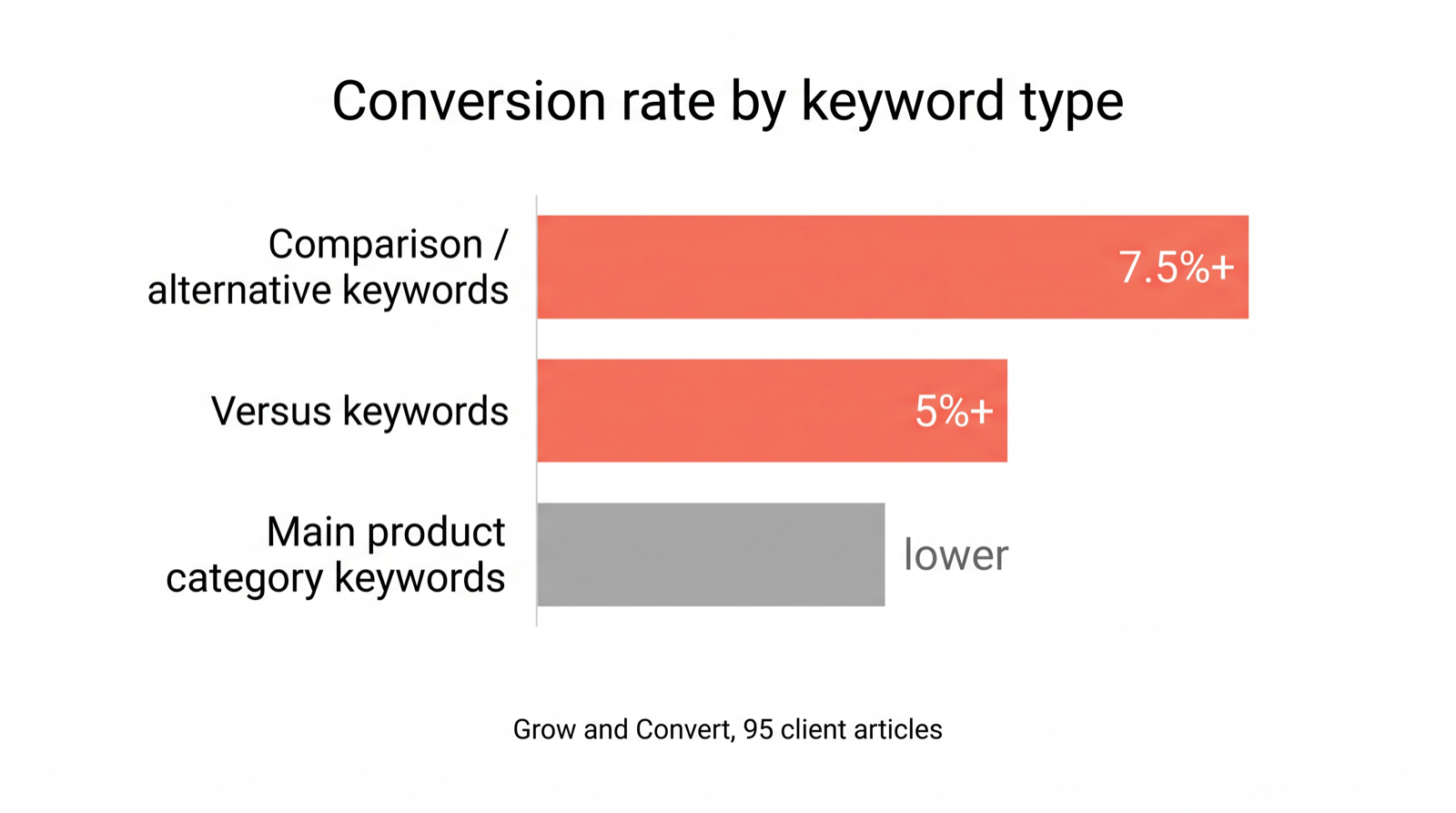
Grow and Convert analyzed 95 articles they'd written for clients and found comparison and alternative keywords converted better than anything else they measured: over 7.5% for comparison and alternative keywords, over 5% for "versus" keywords, both ahead of main product category keywords.1 They also make the point that the search-volume estimates lie in your favor here. In one client example, six comparison articles — every one showing under 20 monthly searches — collectively drove 149 organic signups, with one converting at 4.5%. And for a client with a domain rating of 28, five out of five comparison keywords landed in the top three results.
Rework's guide to comparison and alternatives pages makes the mechanism explicit: competitors spend money building brand awareness, that awareness turns into branded search volume, and a comparison page lets you take a slice of it without paying for the awareness yourself.2 It opens with a project management SaaS that supposedly pulled $500K in ARR out of a single comparison page at a 23% trial conversion rate — unnamed company, no methodology, so weigh that like you'd weigh any anonymous case study. The underlying logic still holds. Somebody typing "X alternative" has already decided to leave. You don't have to sell them on changing, only on where to go.
The good version of the playbook also tells you to be honest. That same guide argues that admitting where a competitor is better is what makes the rest of your comparison believable, and that "we're better at everything" reads as fluff.
So this isn't a post about comparison pages being dirty. They work, and most companies should follow the advice. Here's why we're the exception.
Where competitor comparison pages break for a tool like ours
Four reasons, none of them moral.
1. Our obvious targets are the things we're standing on
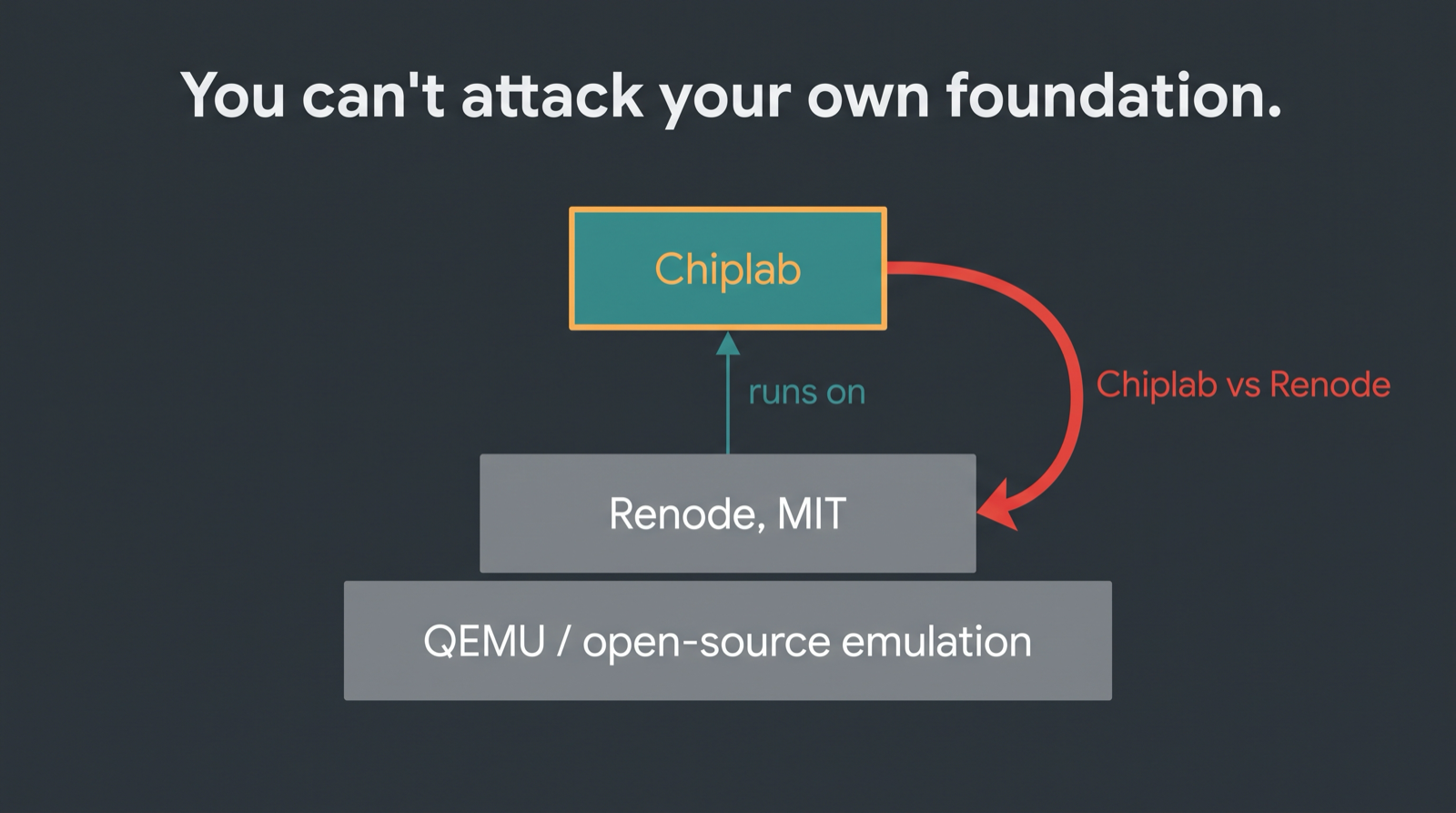
Chiplab runs on Renode. Not "is inspired by" — runs on. A "Chiplab vs Renode" page is a company writing an argument against its own dependency, which is incoherent before you get to the first table row. QEMU is in the same bucket for a different reason: it's infrastructure that a large chunk of the industry, us included, relies on. You don't get to call the foundation slab a competitor.
The best evidence that this isn't posturing is what happened when we ran the honest version anyway. In our QEMU on Cortex-M writeup, the same ELF killed QEMU instantly with a lockup — and Renode, the thing under our own stack, ran the broken firmware to completion and printed clean output. QEMU was right. We were wrong. That's the finding, and it's the first line of the post. On a "vs" page that result gets buried in paragraph nine or it doesn't get published.
2. There's no incumbent search volume to intercept
Comparison pages are demand capture. They work by standing in front of demand somebody else created. Chris Schreiber, who has worked on category creation from Google Docs onward, puts the constraint plainly: if you're creating a category, "most likely people aren't really searching on it today and you have to create that conversation."3
Nobody types "Chiplab vs" anything. Nobody types "hardware target for a coding agent" either. There is no incumbent in "MCU simulation an agent can call over MCP" whose branded traffic I could siphon, because the query doesn't have volume behind it yet. Optimizing a page for a search nobody performs is not a strategy, it's a hobby.
3. Embedded engineers read a comparison table the way they read a diff
This is the audience problem, and it's the one I'd weight highest.
Developer-tool content has a verification step baked in that most B2B content doesn't: developers run the code. Hackmamba's guide to devtools SEO makes the point that a single broken code sample in a tutorial immediately reduces trust in the product, and that generic content built on broad commercial keywords consistently fails this audience.4 Embedded engineers are the extreme end of that. Give them a table with a row about their chip and they will check that row against the datasheet, and they will find the one cell you got wrong.
I know because I found one. The best-ranked page for "Renode alternatives" lists Renode's license as Apache 2.0. It's MIT, and it says so in the README. That single wrong cell is the entire subject of the opening of our honest Renode alternatives post, because it proves nobody opened the repository before publishing the table.
4. A "vs" page is a liability with a timer on it
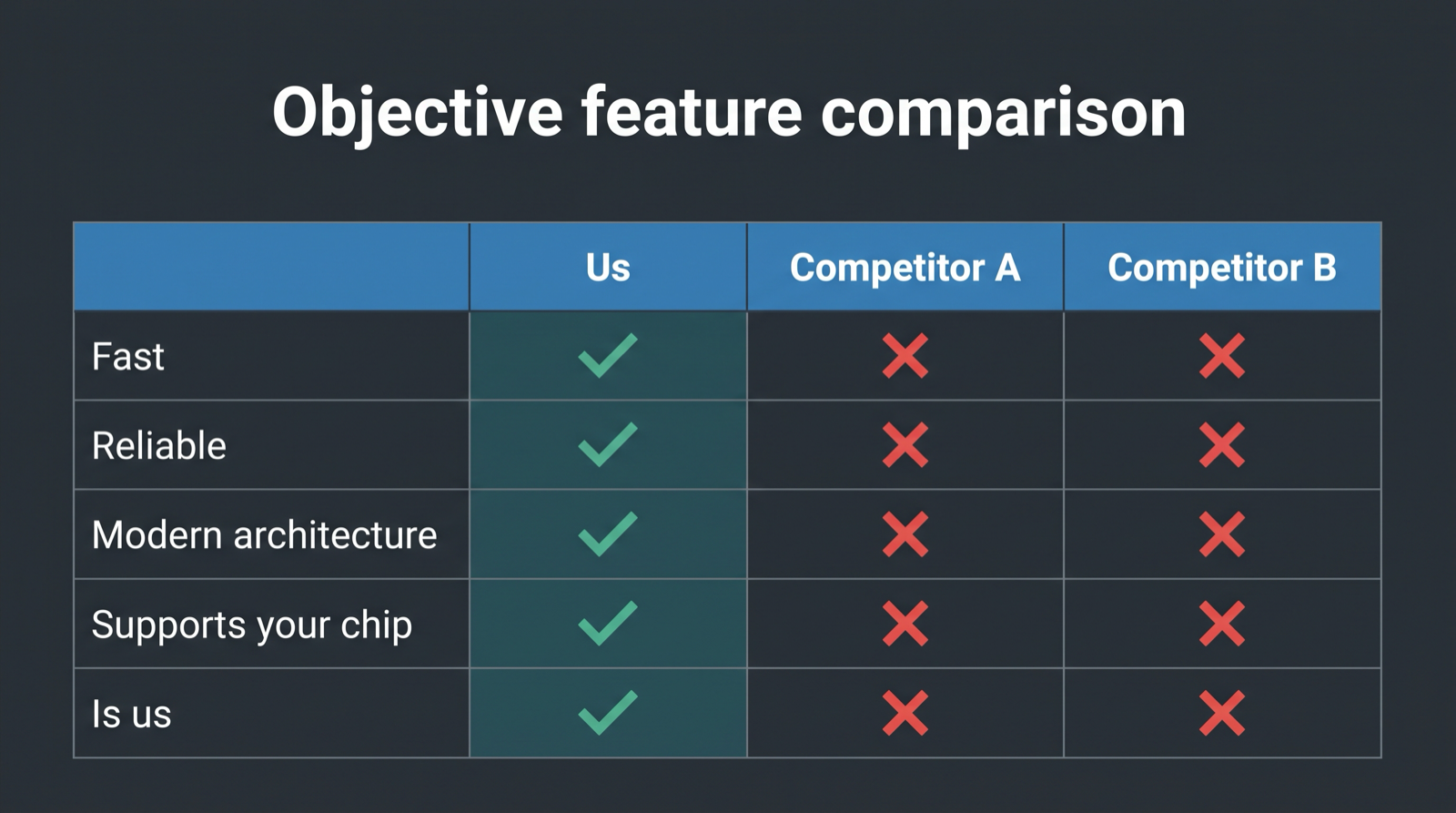
Feature tables decay. The competitor ships the thing your table says they don't have, and now you're the one hosting a wrong claim about somebody else's product with your logo on it. You will not notice, because nobody re-reads their own comparison pages.
Content organized by what a tool fundamentally models ages at a completely different rate. What Renode and QEMU each model is a post about architecture, and architecture moves in years. "We have feature X and they don't" moves in weeks.
The "vs" page versus the honest comparison post
| Classic "vs" page | Honest comparison post | |
|---|---|---|
| Written for | A buyer already leaning your way | Someone deciding what tool fits a job |
| Optimizes for | Conversion on one query | Being correct, and being reused |
| Conclusion | Fixed before the first row is written | Discovered while writing; can go against you |
| Reader who already knows the competitor | Spots the framing, leaves | Recognizes the trade-off, keeps reading |
| Aging | Wrong the week the competitor ships | Stable while the architecture is stable |
| One wrong cell costs | The whole page's credibility | A correction |
| Can it say "don't switch" | No | Yes, and it has to |
What we write instead, and the receipts
Comparisons organized by job, not by opponent. Renode alternatives, by what you're actually trying to do spends a whole section on the reasons that look like reasons to switch but aren't, and tells you to stay put in most of them. Wokwi alternatives for professional firmware work sorts tools by the question you're asking instead of ranking them, because "browser toy" and "CI gate" and "agent-accessible target" are three different purchases.
Failures published as failures. An agent tried to fix a HardFault is a post about our own tool not modeling fault escalation, which is why the experiment produced nothing. It shipped anyway.
Our own limits, documented in detail. What simulation can't catch is a field guide to our stack silently returning zeros for a cycle counter that doesn't exist on the virtual board, and inventing RAM that isn't there. No error, no warning. That post is more useful to a prospective user than any table I could build, and it is unambiguously bad for a demo.
"You're still writing comparison content, you're just calling it teaching"
Yes. Mostly.
This post has a primary keyword. It's part of a batch of ten written against an SEO rubric. The Renode post is aimed squarely at "Renode alternatives," which is a comparison keyword by any definition, and Grow and Convert would recognize it instantly as strategy one from their own article: use a blog post instead of a landing page, because blog posts rank better and convert fine. I am running the playbook I just spent a thousand words declining.
The distinction I'll actually defend is narrow: we don't fix the conclusion before we write. That's it. Everything else — the keyword research, the internal links, the tables — is the same machinery. The proof that the constraint is load-bearing is that the QEMU post exists and says we lost, and that the simulation-limits post lists the ways our own tool will lie to you. A rigged process doesn't produce those files.
And the self-interest is obvious, so I'll say it out loud rather than let you find it: acknowledging trade-offs and the cases where you're not the right answer is itself the recommended way to earn trust with developers.5 Honest comparison is good marketing for a tool that isn't the default choice yet. I'm not doing this from a hilltop. I'm doing it because for us it's the only version that survives contact with the reader.
If "Chiplab vs" ever becomes a query with real volume behind it, come back and hold me to this post. Until then the only comparison worth writing is the one where we might lose.
Sources
Footnotes
-
Cameron Brown, "Competitor Comparison Landing Pages: 3 Unique Strategies," Grow and Convert, last updated October 12, 2023. https://www.growandconvert.com/seo/competitor-comparison-landing-pages ↩
-
"Comparison & Alternative Pages: Capturing High-Intent Traffic," Rework Resources, SaaS Growth library. https://resources.rework.com/libraries/saas-growth/comparison-alternative-pages ↩
-
David Khim, "How to Create and Capture Demand for a Brand New Product Category," Omniscient Digital, interviewing Chris Schreiber, Head of Marketing at Qwilr. https://beomniscient.com/blog/chris-schreiber-create-capture-demand ↩
-
"SEO Agencies for Developer Tools," Hackmamba. https://hackmamba.io/technical-content/seo-agencies-developer-tools ↩
-
Avthar Sewrathan, "'Developers hate being marketed to' — I think that's a myth," Developer Marketing Club, May 10, 2023. https://devmarketing.club/p/developers-hate-being-marketed-to ↩