%20--%3e%3cpath%20d='M2025.4,806.8c-2.5,20.1-16.2,38.2-34.5,45.1-3.4,1.3-8.4,2.3-14.6,3.2-14.2,1.9-34.3,2.8-53.7,2.7h-.2c-23.1-.1-45.1-1.7-54.4-4.4-2.5-.7-4.9-1.6-7.2-2.7-.2,0-.3-.2-.5-.2-8.2-3.8-15.6-9.8-21.1-17.1-5.7-7.6-9.4-16.8-10-27,0,0,0,0,0,0-.5-3.1-.8-6.3-1.1-9.7-.5-7.2-.9-16.4-1-26.5h281.9c0-63.9-2.2-130.2-61.1-167.8-37.4-23.8-95.6-24.8-152.9-22.2-52.8,2.3-90.5,17.6-115.3,46.6-24.2,28.3-35.5,68.9-34.5,125.8h0c.2,12.6,1,26,2.4,40.2.3,3.1.6,6.2,1,9.4,2.9,25.9,12.9,50.3,28.9,70.4,10.9,13.8,24,24.9,38.8,32.8,7.6,4.1,15.7,7.4,24.1,9.8,17.8,5,52.5,7.8,87.8,7.8s64.2-2.2,84.5-7.1c2.9-.7,5.5-1.4,7.8-2.2,45-15,82.5-60.5,85.6-106.7h-80.6ZM2025.3,709.9h-198.3v-2.6c0-33.2,26.7-58.2,64.8-58.2h72.8c30.3,0,60.8,24.9,60.8,58.2v2.6Z'/%3e%3cpath%20d='M1620.8,806.8c-2.5,20.1-16.2,38.2-34.5,45.1-3.4,1.3-8.4,2.3-14.6,3.2-14.2,1.9-34.3,2.8-53.7,2.7h-.2c-23.1-.1-45.1-1.7-54.4-4.4-2.5-.7-4.9-1.6-7.2-2.7-.2,0-.3-.2-.5-.2-8.2-3.8-15.6-9.8-21.1-17.1-5.7-7.6-9.4-16.8-10-27,0,0,0,0,0,0-.5-3.1-.8-6.3-1.1-9.7-.5-7.2-.9-16.4-1-26.5h281.9c0-63.9-2.2-130.2-61.1-167.8-37.4-23.8-95.6-24.8-152.9-22.2-52.8,2.3-90.5,17.6-115.3,46.6-24.2,28.3-35.5,68.9-34.5,125.8h0c.2,12.6,1,26,2.4,40.2.3,3.1.6,6.2,1,9.4,2.9,25.9,12.9,50.3,28.9,70.4,10.9,13.8,24,24.9,38.8,32.8,7.6,4.1,15.7,7.4,24.1,9.8,17.8,5,52.5,7.8,87.8,7.8s64.2-2.2,84.5-7.1c2.9-.7,5.5-1.4,7.8-2.2,45-15,82.5-60.5,85.6-106.7h-80.6ZM1620.8,709.9h-198.3v-2.6c0-33.2,26.7-58.2,64.8-58.2h72.8c30.3,0,60.8,24.9,60.8,58.2v2.6Z'/%3e%3cpath%20d='M2968.1,806.8c-2.5,20.1-16.2,38.2-34.5,45.1-3.4,1.3-8.4,2.3-14.6,3.2-14.2,1.9-34.3,2.8-53.7,2.7h-.2c-23.1-.1-45.1-1.7-54.4-4.4-2.5-.7-4.9-1.6-7.2-2.7-.2,0-.3-.2-.5-.2-8.2-3.8-15.6-9.8-21.1-17.1-5.7-7.6-9.4-16.8-10-27,0,0,0,0,0,0-.5-3.1-.8-6.3-1.1-9.7-.5-7.2-.9-16.4-1-26.5h281.9c0-63.9-2.2-130.2-61.1-167.8-37.4-23.8-95.6-24.8-152.9-22.2-52.8,2.3-90.5,17.6-115.3,46.6-24.2,28.3-35.5,68.9-34.5,125.8h0c.2,12.6,1,26,2.4,40.2.3,3.1.6,6.2,1,9.4,2.9,25.9,12.9,50.3,28.9,70.4,10.9,13.8,24,24.9,38.8,32.8,7.6,4.1,15.7,7.4,24.1,9.8,17.8,5,52.5,7.8,87.8,7.8s64.2-2.2,84.5-7.1c2.9-.7,5.5-1.4,7.8-2.2,45-15,82.5-60.5,85.6-106.7h-80.6ZM2968,709.9h-198.3v-2.6c0-33.2,26.7-58.2,64.8-58.2h72.8c30.3,0,60.8,24.9,60.8,58.2v2.6Z'/%3e%3cpath%20d='M2402,586.8c-33.3-9.5-98.1-9.6-133.7-3.3-28.1,4.9-55.3,19.7-76.7,41.5-21.4,21.8-35.7,49.3-40.3,77.5-10.8,65.9,0,123.9,30.3,163.2,24.8,32.1,61.3,50.7,108.4,55.2,14.2,1.3,27.5,2,40.1,2,30.6,0,56.9-4,79.6-12,39.8-14,69.4-40,86-79.2,8.9-20.9,11.3-36.7,11.3-59.5v-1h-78.2s1.1,63.5-43.7,75.9c-26.4,6.3-75.2,4-98.6,2.3-17.8-1.3-31.6-7.1-41-17.3-9-9.8-14.2-24-15.4-42.1-1.9-28.8-2.6-90.3,7.3-109.2,7.1-13.5,21.4-23.8,37.3-27,23-4.5,98.1-4.2,117.7,3.4,37.1,14.4,36.3,55.9,36.3,55.9h78.2v-2c0-26.6-10.5-55.1-31.4-78.7-19.5-21.9-47-37.8-73.7-45.4Z'/%3e%3crect%20x='2557.8'%20y='492.7'%20width='80.1'%20height='422.1'/%3e%3cpolygon%20points='1119.3%20831.5%201007.4%20585.6%20913.1%20585.6%201065%20913.6%201065.5%20914.8%201173%20914.8%201325.4%20585.6%201231.2%20585.6%201119.3%20831.5'/%3e%3cpolygon%20points='265%20601.6%20265%20810.4%20627.6%201019.1%20627.6%201019.1%20627.6%201019.1%20627.6%201019.1%20627.6%201019.1%20808.9%20914.8%20808.9%20706%20627.6%20810.4%20265%20601.6'/%3e%3cpolygon%20points='808.9%20706%20808.9%20497.2%20627.6%20601.5%20808.9%20706'/%3e%3c/svg%3e)
Wokwi vs Renode vs QEMU: hobby, professional, and CI tiers of embedded simulation
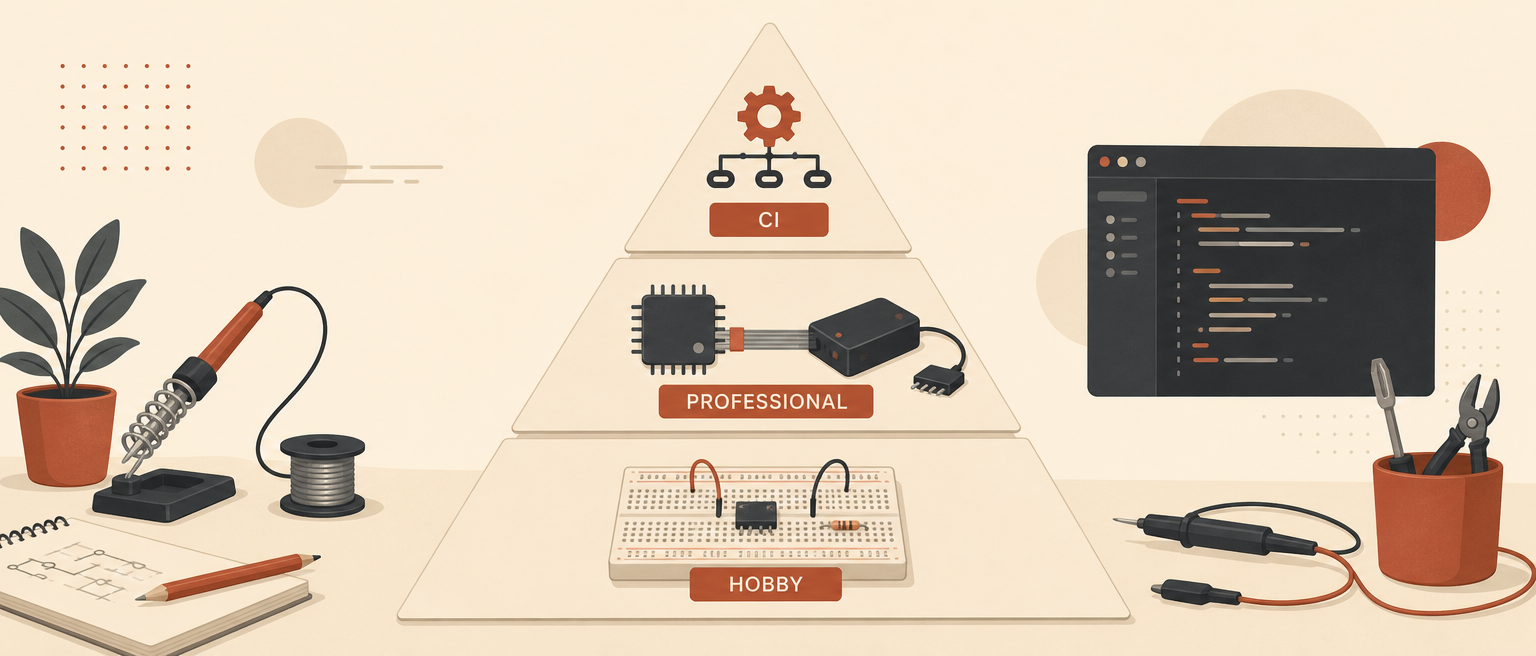
People search "Wokwi vs Renode vs QEMU" expecting a shootout. A winner, a runner-up, and one you avoid.
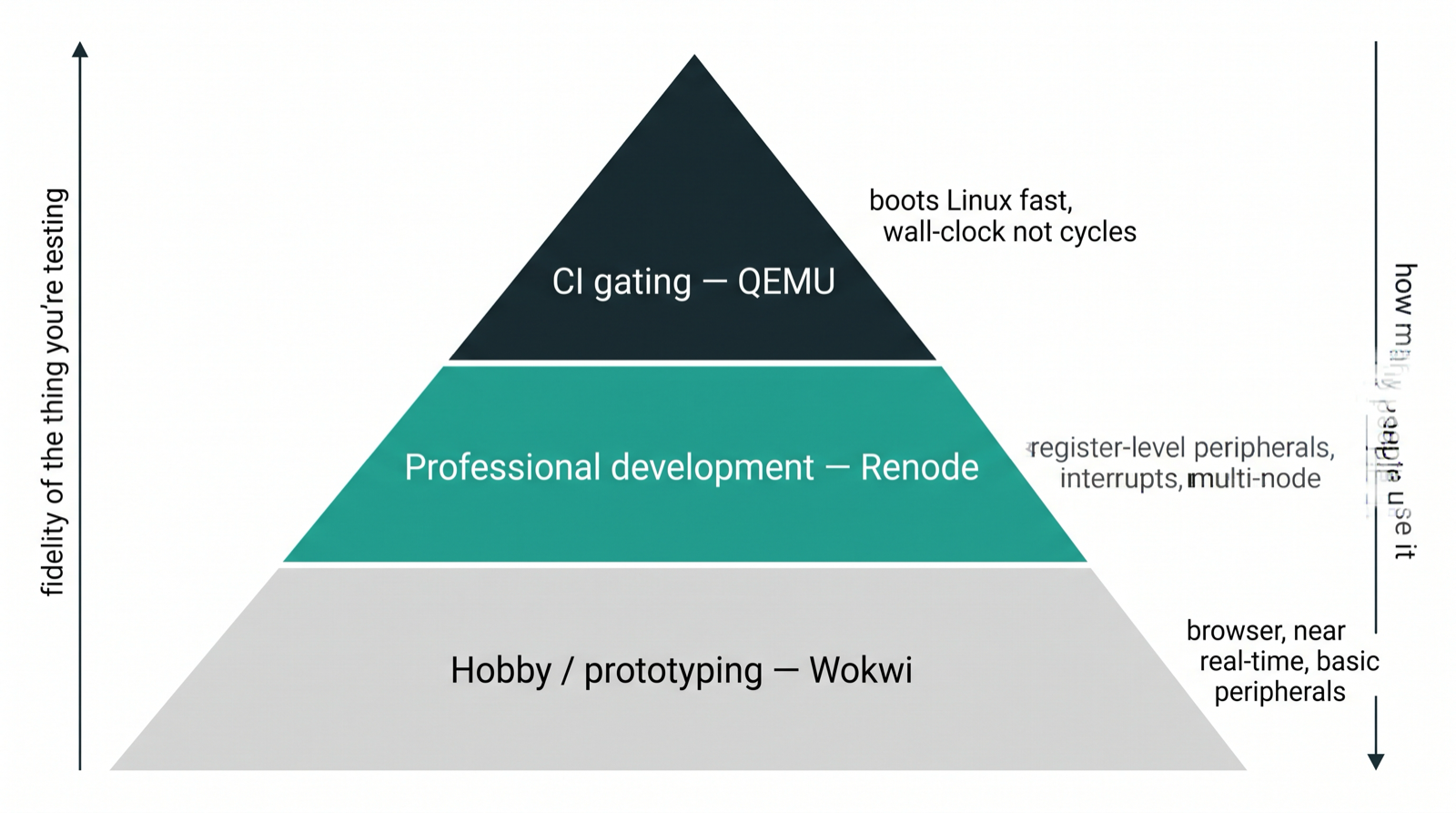
That's the wrong shape for the question. These three tools barely overlap. Wokwi is where you prototype, Renode is where you develop firmware seriously, QEMU is where you gate a Linux build in CI. You can use all three in one week on one project and never once have to choose between them.
The reason the shootout framing survives is that the content ranking for the query is written by people who haven't run any of them.
The tier map
| Tier | Tool | What it's for | What it can't do |
|---|---|---|---|
| Hobby / prototyping | Wokwi | Arduino and ESP32 sketches, wiring up LEDs and displays in a browser, teaching, smoke-testing a library | Timing-precise peripherals, a serious build-system integration, most professional MCU families |
| Professional development | Renode | Register-level peripheral models, interrupts, multi-node networks, scriptable regression runs, unusual boards you describe yourself | Cycle counts, analog behavior, power draw, anything off-chip you didn't model |
| CI gating | QEMU | Booting embedded Linux fast, driver and Yocto work, full-system emulation across many architectures | Counting cycles, and the Cortex-M board you actually own is probably not in the list |
Same pipeline, three different jobs. Read that table as a routing decision, not a ranking.
Wokwi: the tier everyone underrates and then overreaches with
Wokwi is a browser tab that runs Arduino, ESP32, RP2040 and friends at near real-time, with LEDs, OLED displays, sensors and motors you drag onto a canvas. No toolchain, no flashing, no cable. Share a link and someone else sees your circuit running.
For its tier that's close to unbeatable. Nathan Jones, writing up simulation options on EmbeddedRelated, guesses the hobbyist and educational tools are the easiest to learn of the bunch, and he's right.1 Uri Shaked, who built Wokwi, calls simulation a superpower, and the reason that lands is that Wokwi removes every excuse not to try something.
The failure mode is treating it as your development environment. Jones puts his finger on the exact cost: updating a Wokwi project means uploading source files, then remembering to propagate the changes back to your real tree. His old coworker's line for that is "the same information in two places, guaranteeing that one of them is always wrong."1 There is a CLI, wokwi-cli, and it will run a simulation, but your interaction with a running sim is limited to the serial port or a predefined automation scenario that was still in alpha when he wrote it.
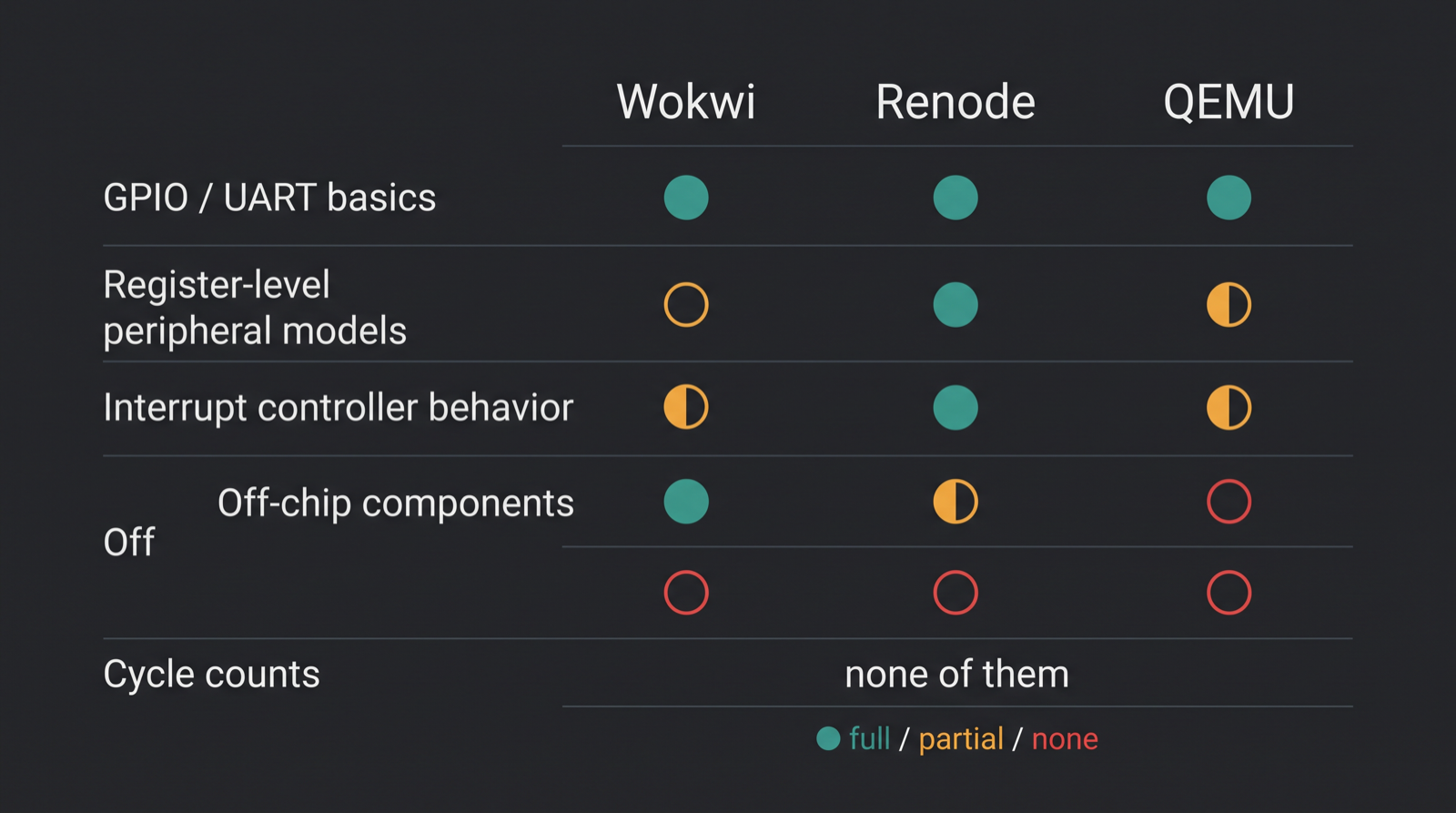
Wokwi also doesn't model timing-precise peripherals. That's not a knock, it's the tier boundary. If your bug is "the DMA completes before the flag is checked," this is not the tool, and no amount of dragging components onto the canvas changes that.
Renode: the professional tier, and the one we build on
Renode is where the peripherals become real. Not "there is a UART" real, but "the UART has registers at the addresses your datasheet says, and writing the wrong bit does the wrong thing" real. Interrupts, timers, DMA, SPI, I2C, Ethernet, and multi-node setups where several boards talk to each other over a simulated wire.
Chiplab runs on Renode. I'm not going to pretend that's a neutral position. But the reason we picked it is the same reason I'd recommend it to someone with no interest in our product: it's the only tool in this group where you can add a board that nobody has added before. Platform descriptions are files you write. When the peripheral you need isn't modeled, you model it. That's a real cost in hours and it's also the only escape hatch that exists, because every chip is an island and no vendor is going to ship yours.
One correction to Jones here, because he's slightly off on this one. He puts Renode and QEMU in the bucket of simulators that don't support external components.1 For QEMU that's fair. For Renode it isn't quite: off-chip devices go in the platform description like everything else, which is how you get a simulated I2C sensor answering your driver. It's a text file instead of a drag-and-drop canvas, which is probably why it reads as "unsupported" from outside.
What Renode will not do is count cycles. There is no cycle-accurate mode. It executes instructions and advances a virtual clock, which is a completely different thing from telling you how many cycles your loop took. We wrote up where that bites in what simulation can't catch, including our stack cheerfully returning zeros from a cycle counter that doesn't exist on the virtual board.
QEMU: the CI tier, and the narrowest board list of the three
QEMU is infrastructure. It boots Linux on ARM, AArch64, RISC-V, MIPS, PowerPC and x86, it plugs into Yocto, and it's fast. If you're doing embedded Linux, driver work, or filesystem validation, this is your tool and the other two aren't in the conversation.
Two things get misread about it constantly.
First, QEMU does not count cycles. It counts wall-clock time. People assume "full-system emulation" implies timing fidelity, and it doesn't.
Second, the Cortex-M board list is short. When we went looking, QEMU shipped exactly five STM32 machines, and none of them was the F4-Discovery, which is one of the most common dev boards on earth. Details and the full list are in QEMU for Cortex-M. That post also contains the result I liked least and trust most: QEMU killed a broken ELF instantly with a lockup, and Renode ran the same broken firmware to completion and printed clean output. QEMU was right. We were wrong.
So the CI tier isn't "worse." It's stricter about a narrower set of things. That's what you want from a gate.
The license cell, and why you should distrust the table you're reading
Now the part that made me want to write this.
The page ranking for "Wokwi vs Renode vs QEMU" belongs to industrialmonitordirect.com, a company that sells industrial panel PCs, in the knowledgebase section, and it ends with a CTA to configure a panel PC.2 Most of its comparison table is fine. Wokwi targets Arduino and ESP32 with basic peripherals, Renode targets Cortex-M and RISC-V with advanced ones, QEMU does full-system emulation. Their recommended pipeline — Wokwi or Renode for unit tests, Renode for integration, QEMU for Linux systems, hardware for final validation — is roughly the tiering I just spent a thousand words on. Credit where it's due.
The license row says Renode is "Open-source (Apache 2.0)."
It's MIT. Open any Renode repository on GitHub and read the LICENSE file. This takes fifteen seconds and it is the single easiest cell in the entire table to get right, because unlike every other row it requires zero judgment. It's a lookup.
That exact error is the opening of our Renode alternatives post, where the top-ranked page for a different query made the identical mistake. Two independent pages, same wrong cell. Nobody opened the repository. And the same column lists Wokwi's license as "Freemium," which is a pricing model.
I'm being narrow on purpose. One wrong cell doesn't make a table useless, and I'd rather name the specific verifiable error than wave at the whole thing and call it slop. But the license cell is the cheapest possible fact-check in the document, and it's wrong, which tells you exactly how the rest of the rows were produced: from general knowledge of what these tools are, not from running them. That's fine for a rough orientation. It's not fine as input to a decision you'll live with for two years.
We went and read every comparison of this shape we could find, and we read every comparison like this one has the full tally. This post only needs one data point from it.
How to actually choose
Jones proposes three questions for evaluating virtual hardware, and they beat any feature table because they're about your project instead of the tool's marketing.1
Does it support your MCU and your external components? Start here, because it eliminates fastest. Notably, Jones argues a missing MCU isn't automatically fatal if your code is written to not care which processor it runs on, and that a missing sensor can often be substituted with something that produces a similar value. If neither your chip nor your components are supported, skip simulators entirely and compile for your host with printf. For a specific STM32 or nRF part, Renode is usually the answer, and if the board isn't there you write the platform file. For an ESP32 with a display and a servo, Wokwi already has all three. For anything that boots Linux, QEMU.
How easy is it to learn? This one is about total time budget. Setting up the simulation has to cost a fraction of building the project, or you've lost the benefit. Wokwi wins outright. Renode has a real learning curve, especially platform descriptions. QEMU's curve depends entirely on whether your board is already supported, and it's steep on the far side of that.
How well does it fit your build system? Jones gives the edge to the command-line tools, Renode and QEMU, and puts the graphical ones at a disadvantage because updating the sim means moving files around.1 I'd sharpen it: the question is whether one command rebuilds and reruns. If a human has to click, it will not run on every commit, and a simulation that doesn't run on every commit is a demo.
For us that last question is the whole product. An agent writing firmware needs a target it can call without a human in the loop, which is why Chiplab is Renode behind MCP rather than a nicer UI on top of it. The code takes minutes. Proving it works is the part that takes months, and it only gets shorter if the proof step is one command.
Pick by the job
If you're learning, or wiring up a sensor to see if the idea holds, open Wokwi. If you're writing drivers for a specific part and you need the registers to behave, Renode. If you're gating a Linux image in CI, QEMU. If you need cycle counts, none of these, go get the board.
Nobody wins, because they were never in the same race.
Sources
Footnotes
-
Nathan Jones, "Simulating Your Embedded Project on Your Computer (Part 2)," EmbeddedRelated, November 4, 2024. https://www.embeddedrelated.com/showarticle/1697.php ↩ ↩2 ↩3 ↩4 ↩5
-
Industrial Monitor Direct, "Wokwi vs Renode vs QEMU: Embedded System Simulators Comparison," knowledge base, accessed August 5, 2026. https://industrialmonitordirect.com/blogs/knowledgebase/wokwi-vs-renode-vs-qemu-embedded-system-simulators-comparison ↩